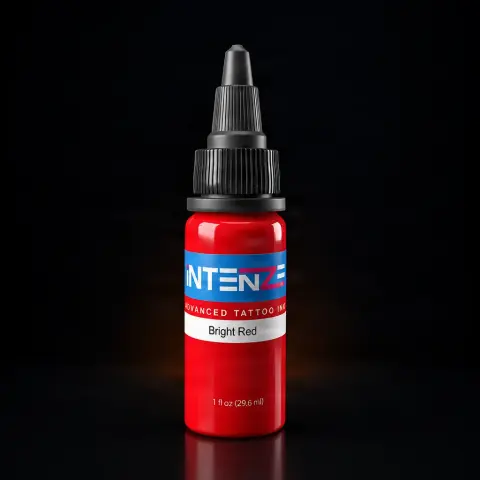
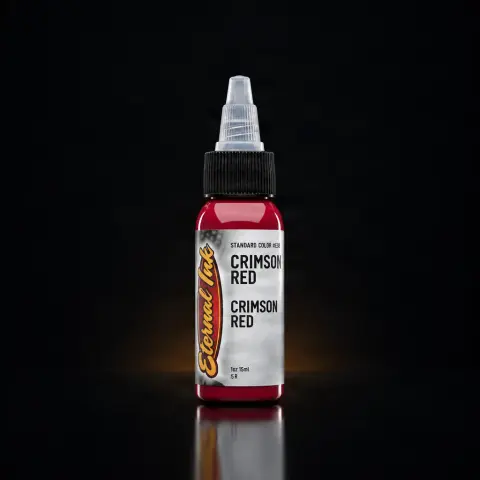
A light red drawing ink from the Eternal range, supplied in a 30 ml bottle — a warm, bright red shade positioned chromatically between intense crimson red and pink. It is designed for artists who sketch, create flash art, color studies, or practice on training surfaces, not for tattooing. If you want to build your red palette for drawing and preparatory projects, this is the transition step between dark and light tones.
Can I tattoo with this ink?▾
No. The product is explicitly declared as drawing ink, not for tattoos, and using it for any purpose other than stated is strictly the consumer's responsibility. If you need pigments for tattooing, choose the range of dedicated tattoo inks — this product remains a studio tool for sketches, flash art, and color studies.
What exactly do I use it for, as a tattoo artist?▾
It is useful wherever you need a light, warm red on paper or training surfaces: sketches and flash art in color, gradient studies (from dark red to highlight), planning a project's palette before working on a client, and chromatic transition exercises. Basically, it lets your hand and eye get used to the behavior of a light red before the real work.
How does Light Red compare to other reds, and how do I choose the right shade?▾
According to the description, Light Red is a lighter red than Crimson Red but more intense than pink — the transition tone between dark and light reds in the palette. Choose it when you need the bright areas of a red gradient (e.g., the illuminated parts of petals in a rose study) or when you want a warm red ready-calibrated without manually mixing a dark red with white every session.
Can it be mixed with other inks?▾
Yes, the description mentions it mixes well with the rest of the Eternal range, making it suitable for color studies: you can build transitions to darker or lighter tones directly on paper. Make mixes in separate containers, in small quantities, and note your proportions — this way you get the same tone next time. Avoid mixing with products of a different chemical nature (watercolors, inks on another base), as the result can be unpredictable.
How do I store the ink to keep it from degrading and remain hygienic?▾
Three simple rules: always work from a separate container and do not pour leftover ink back into the bottle; do not touch the bottle neck with used brushes or tools; close the cap tightly immediately after pouring. Store the bottle in a cool place, away from sunlight. If you notice a changed smell, separation that does not recombine on shaking, or lumps, it is safer not to use the contents.
How long does a 30 ml bottle last?▾
It depends on how often you draw and the surfaces covered, but for sketches, flash art, and color studies — where you use small amounts poured into a container — 30 ml usually lasts for many sessions. Working from separate containers helps you dose only what you need, without waste and without compromising the rest of the bottle.