
Adhesive Rash vs Ink Allergy: How to Tell Them Apart Under Your Healing Film
You peel off the healing film and the skin around your tattoo is red, puffy, and itching badly. The first thought is usually "I'm allergic to the ink" — but in most cases the real culprit is the film's adhesive, not the pigment sitting in your skin. That mix-up leads to bad calls, like distrusting a good tattoo artist or dreading future sessions, when the fix is often just switching bandage brands. Here's exactly how to distinguish adhesive contact dermatitis, ink allergy, and infection.
Itching under the edge of your tattoo aftercare film is almost always contact dermatitis from the adhesive, not an ink allergy — here's how to tell the two apart, and from infection.
Why the two reactions get confused
Second-skin healing film is a transparent acrylic-adhesive sheet applied directly on the skin, covering both the tattoo and a border of untattooed skin around it. When skin reacts to the glue, the itching and redness show up right there — over the tattoo and around it — so it feels natural to blame the freshly deposited ink. In reality, the two reactions have different causes, different shapes, and different timing.
Adhesive contact dermatitis — the most common cause
This is an irritant or allergic reaction to the glue itself (often acrylate-based), not to the ink. According to Mayo Clinic and NHS guidance, contact dermatitis typically shows up within hours to a few days of exposure, causing redness, itching, dryness, and sometimes small clear fluid-filled bumps.
- The rash follows the exact shape of the film — you'll often see a clean rectangle or geometric edge of redness, not just the tattooed area.
- It extends onto UNtattooed skin under the film's border, where only adhesive touched the skin, no ink underneath.
- It usually appears within the first 12-48 hours of applying the film, sometimes only on the second film applied, as sensitization can build up over repeated exposure.
- It noticeably calms down within 1-3 days once you remove the film and switch to non-occlusive aftercare.
If the redness has a straight or geometric edge and spills onto clean skin beyond the tattoo outline, it's almost certainly the adhesive, not the ink.
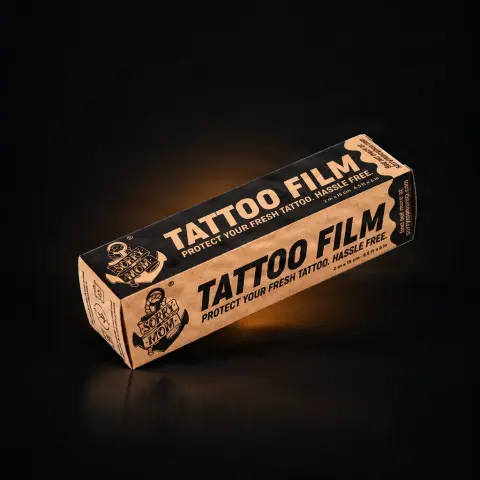
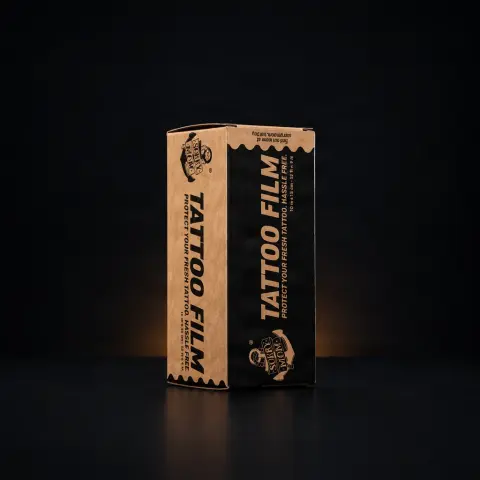
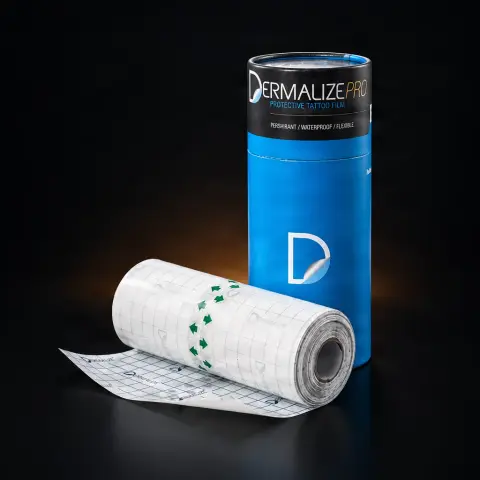
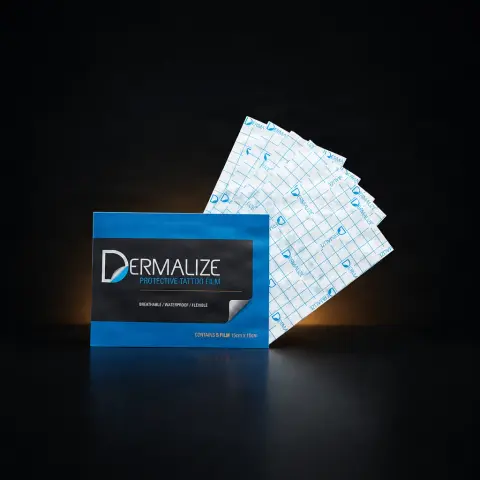
Alternative healing films with gentler adhesive
Ink allergy — rarer, and a different pattern
Pigment allergy is real, but it's meaningfully rarer than adhesive dermatitis. Studies cited by dermatologists put the overall rate of adverse tattoo reactions at around 10%, with nearly half of color-specific reactions linked to red ink (historically tied to mercury- or cadmium-based compounds in some older formulas).
- The reaction strictly follows the design's outline — in a multi-color piece, often only the area with one specific color (frequently red) becomes raised, swollen, or bumpy, while black linework stays flat.
- It can appear immediately, but just as often shows up weeks, months, or even years after the session — there are documented cases of reactions appearing 17-20 years after tattooing.
- Untattooed skin around the design usually stays normal.
- It doesn't improve just by switching film or cream — it persists and can flare cyclically.
If itching or swelling appears STRICTLY on one color, on a tattoo that's months or years old, with no recent product changes, think pigment allergy rather than adhesive — and see a dermatologist for evaluation.
What infection looks like, so you don't mistake it for either
Some redness, tenderness, and warmth are normal in the first few days after tattooing — the skin just went through repeated needle trauma. What is NOT normal, according to medical sources on tattoo aftercare, are the signs below, which point to infection and need medical evaluation, not just a film swap:
- Redness that spreads and worsens after the first day or two, instead of gradually settling down.
- Thick yellow or green discharge (pus), different from the clear or light-yellow, odorless plasma typical of normal healing.
- The area getting progressively hotter to the touch instead of cooling down.
- Red streaks radiating outward from the tattoo — an emergency sign, possibly infection spreading through the lymphatic system.
- Fever, chills, or feeling generally unwell.
| What to check | Adhesive dermatitis | Ink allergy | Infection |
|---|---|---|---|
| Where it shows up | Along the film's outline, with a geometric edge; spills onto UNtattooed skin under the border | Strictly inside the design, often on one color only (frequently red); surrounding skin stays normal | In and around the tattoo, redness spreading outward with no particular shape |
| When it starts | Within 12-48 hours of applying the film; sometimes only on the second film, as sensitization builds | Immediately or late — weeks, months, years later; documented cases 17-20 years after tattooing | After the first day or two, exactly when normal redness should have been settling down |
| What it looks like | Redness, itching, dryness, sometimes small clear fluid-filled bumps | Raised, swollen or bumpy skin on one color only; black linework stays flat | Thick yellow or green discharge (pus), increasing warmth, red streaks, fever or chills |
| What happens after removing the film | Calms down noticeably within 1-3 days on non-occlusive aftercare | No change — it persists and can flare cyclically, whatever film or cream you use | Keeps getting worse; the direction is always downhill |
| What to do | Remove the film, switch to non-occlusive aftercare; optionally try a film with a different adhesive | See a dermatologist to have the pigment reaction assessed | See a doctor without delay (red streaks or fever are an emergency) |
Adhesive dermatitis and ink allergy follow a SHAPE pattern (adhesive rectangle vs. design outline). Infection follows a DIRECTION pattern — things get worse instead of better, regardless of shape.
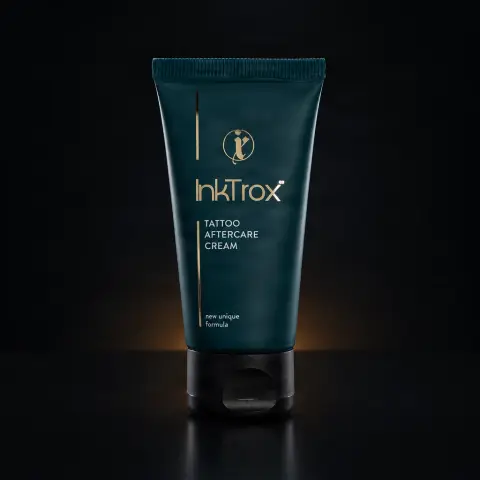
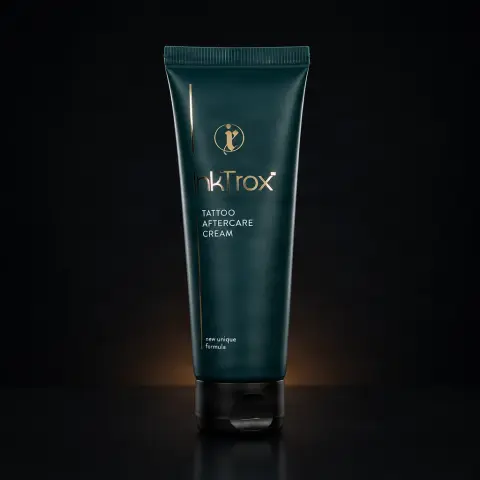
Fragrance-free healing balms for sensitive skin

What to actually do, step by step
- Remove the film if you notice intense itching, spreading redness, or small blisters — don't leave it under occlusion hoping it passes on its own.
- Gently wash the area with water and mild soap, pat dry, don't rub.
- Check exactly where the reaction sits: all around the film's border (including clean skin) points to adhesive; strictly on one design color points to pigment.
- Switch to non-occlusive aftercare — a thin layer of cream, open air, no film — and monitor for 24-48 hours.
- If the reaction clearly fades within 1-3 days after removing the film, it was adhesive contact dermatitis.
- If the reaction persists strictly on one color, for weeks or shows up much later, talk to a dermatologist about pigment allergy.
- If infection signs appear (spreading redness, pus, increasing warmth, red streaks, fever) — see a doctor, don't wait it out.
This article is for informational purposes and doesn't replace medical advice. For any reaction that doesn't improve within a few days, spreads, or comes with fever, see a dermatologist, or start with the tattoo artist/piercer who worked on you for an initial look at the area.
See all tattoo aftercare products →
Surse și referințe
- Mayo Clinic — Contact dermatitis: Symptoms and causes
- NHS — Contact dermatitis
- Cleveland Clinic — Contact Dermatitis: Symptoms, Causes, Types & Treatments
- American Academy of Dermatology — Tattoos: 7 unexpected skin reactions and what to do about them
- Medical News Today — Tips for identifying and treating a tattoo allergy
- NBC News — Man has skin reaction to tattoo, 20 years later
- Saniderm FAQ — Could I Have An Allergic Reaction to Saniderm?
Întrebări frecvente
How do I know for sure if it's adhesive or ink allergy?+
Look at shape and location. If the redness/itching has a geometric outline (like a rectangle) and extends onto untattooed skin under the film's edge, it's very likely the adhesive. If the reaction strictly follows the design outline, especially on one color (often red), pigment is more likely. If you're unsure or it doesn't resolve, get a dermatology consult.
How long does adhesive contact dermatitis last?+
It typically improves noticeably within 1-3 days after removing the film and switching to non-occlusive aftercare. If it doesn't improve or gets worse, see a doctor — it could be something else, including infection.
Can I still use healing film after having a reaction?+
You could try a film with a different adhesive formula (some are marketed as more hypoallergenic), but it's not required — you can heal a tattoo without occlusive film, using a thin layer of cream a few times a day instead. Talk to your artist about alternatives.
Can ink allergy show up on a tattoo that's years old?+
Yes. There are documented cases of allergic reactions to pigment appearing years or even decades after tattooing, especially with red ink. If itching or swelling suddenly appears strictly on a colored area of an old tattoo, it's worth a dermatology evaluation.
What's the difference between normal healing redness and infection?+
Normal redness gradually decreases over the first few days. Infection signs go the other way: redness spreads and worsens, yellow-green pus appears, the area gets progressively warmer, red streaks radiate from the tattoo, or fever develops. Any of these need prompt medical evaluation.
Do I need to see a doctor for every itch under the film?+
Not necessarily — mild itching localized right under the film's outline that improves once you remove it is usually plain contact dermatitis. See a doctor if the reaction is severe, spreads, produces large blisters or pus, comes with fever, or lasts longer than 1-2 weeks.