
Freehand vs Stencil: Which Tattoo Styles Actually Work Better Without a Template
Every client who watches an artist draw straight on skin, with no printed guide, asks the same question: is this a trick, or is it actually the better method? Neither wins universally — freehand and stencil solve different problems, and it's the tattoo style that decides which technique fits. This guide breaks down which styles genuinely benefit from freehand, which ones need stencil precision to hold together visually, and what that means for apprentices deciding which skill to build first.
Freehand and stencil aren't interchangeable — some styles genuinely need one over the other. Here's why organic blackwork and tribal favor freehand, while lettering and geometric work depend on strict stencil precision.
What freehand actually means in practice
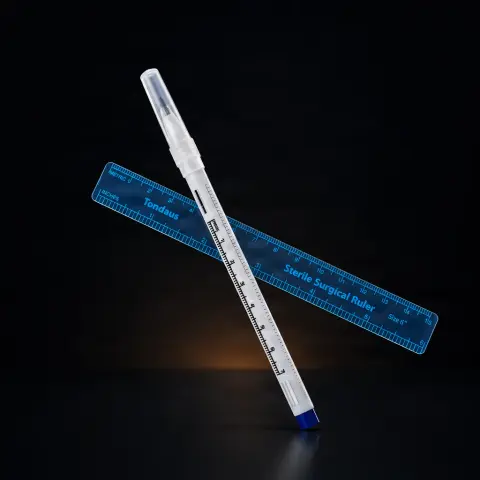
Freehand tattooing means the artist draws the design directly on the client's skin — usually with a surgical skin marker or fine-tip pen — right before tattooing, with no stencil transferred from paper. It isn't improvisation without a plan; most freehand artists already have a rough concept sketched out, but the final lines are drawn live, adjusted to the exact curve of the arm, ribcage, or back in front of them.
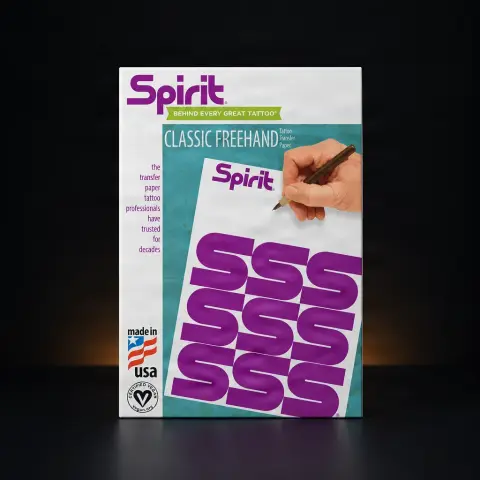
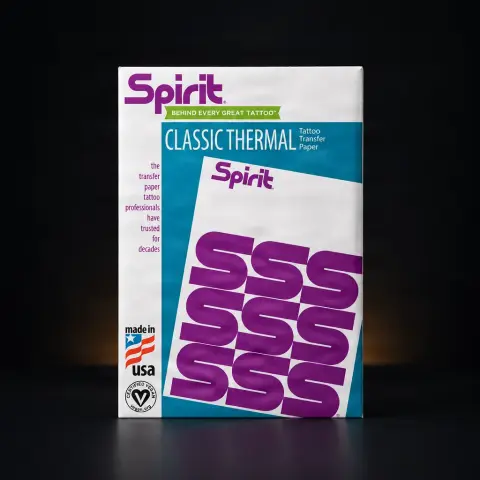
The advantage is anatomical fit. A stencil is flat — drawn on paper or printed with a thermal machine, then transferred onto a three-dimensional, moving body part. Skin stretches differently over a shoulder blade than over a forearm, and a design that looked balanced on paper can end up looking stretched or compressed once it's actually inked. Freehand skips that translation step entirely, because the artist is drawing directly on the final surface.
Why organic blackwork and tribal favor freehand
Organic blackwork, contemporary tribal, and many flow-based compositions (curved lines that follow muscle groups or joints) are among the styles most often worked freehand, for a few concrete reasons. They don't depend on mathematical symmetry — a tribal line that widens or narrows slightly differently from one side to the other doesn't break the design, as long as it follows the piece's visual logic. The composition is built around the body's shape rather than independent of it: the artist can see live how a line reacts to arm movement or muscle relief and adjust on the spot — something impossible to fully anticipate on paper.
Organic blackwork also has a higher visual tolerance for variation — solid black areas and thick lines mask small asymmetries far better than fine-line work does. In practice, the style "forgives" spontaneous adjustments, which makes freehand not just possible but often preferred, since the result reads as more natural on the body than a rigid geometric shape imposed over anatomy.
Surgical markers for freehand sketching
Why lettering and geometric work need strict stencil
At the opposite end, lettering (script, calligraphy, text) and geometric style (mandalas, straight lines, repetitive shapes, axial symmetry) depend almost entirely on millimeter-level precision — exactly what freehand can't consistently guarantee. In lettering, a letter tilted slightly wrong or uneven spacing between characters is spotted immediately and changes how the whole word reads; the human eye is trained to catch deviations from standard letterforms far more easily than deviations from an organic line.
In geometric work the problem is even stricter: a symmetry-based design (mandala, sacred geometry, parallel lines) exposes any error of a few degrees, because the entire composition relies on identical repetition. Here the stencil isn't just a guiding tool — it's a quality-control instrument. The artist can check the design on paper, correct angles and distances before ever touching skin, and use a ruler or a digital stencil printer's precision — none of which can be replicated by hand identically, no matter how experienced the artist is.
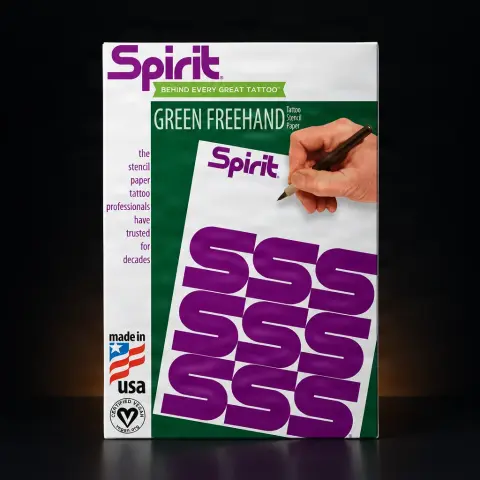
Stencil paper and supplies
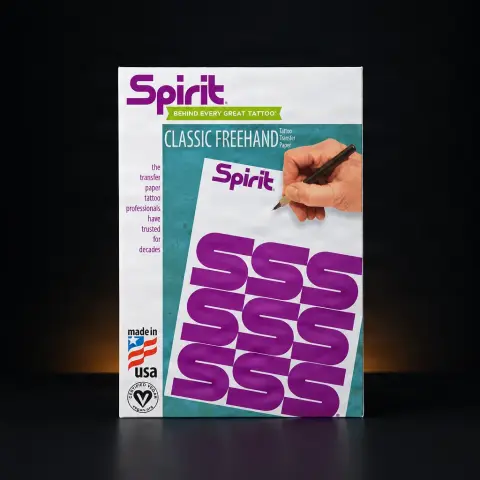
Freehand isn't "more artistic" and stencil isn't "more amateur" — they're different tools for different problems. A skilled lettering artist who refuses stencil out of pride risks uneven letters; an organic blackwork artist who insists on a rigid stencil risks a design that looks pasted onto the body rather than integrated with it. Most professional artists combine both techniques depending on the project, sometimes even within the same piece — stencil for structural elements, freehand for organic transitions.
Hybrid styles: combining both techniques
Many large projects aren't strictly one or the other. A sleeve combining a realistic portrait (stencil required, for facial proportions) with tribal blackwork elements filling the background (freehand, for natural flow) is a typical example. Similarly, neo-traditional pieces often use a stencil for the subject's main outline and freehand for shading and the transitions between elements.
- Stencil for any element with symmetry or text — non-negotiable
- Freehand for filling organic spaces between the fixed elements
- Check the skin with a surgical marker before final tattooing, even on stencil projects, for minor adjustments
- Test under natural or bright light — both stencil transfers and freehand sketches can look different under dim studio lighting
| Style | Technique that fits | Main reason | Tolerance for deviation |
|---|---|---|---|
| Organic blackwork, contemporary tribal | Freehand | The composition is built around the body's shape, and the line is adjusted live to the muscle relief | High — solid black areas and thick lines mask small asymmetries |
| Flow-based compositions over muscles and joints | Freehand | The line has to follow arm or muscle movement, which can't be fully anticipated on paper | High — doesn't depend on mathematical symmetry |
| Lettering (script, calligraphy, text) | Stencil | Letter height and spacing between characters have to stay consistent for the word to read correctly | Low — the eye immediately catches deviations from standard letterforms |
| Geometric (mandalas, sacred geometry, parallel lines) | Strict stencil | Angles and distances are checked on paper, with a ruler or a stencil printer, before touching skin | Very low — an error of a few degrees shows across the whole design, since it relies on identical repetition |
| Realistic portrait | Stencil | Facial proportions don't survive by-eye adjustments | Low — as with any element with fixed proportions |
| Neo-traditional and mixed sleeves | Hybrid: stencil + freehand | Stencil for the main outline and structural elements, freehand for shading and organic transitions | Varies by element — decided piece by piece |
What this means for apprentices
For someone starting out, the temptation is to jump straight to freehand because it looks more impressive to clients. In reality, most serious apprenticeship programs require mastering stencil work first — line control, proportions, correct transfer — before working freehand on a paying client. A stencil offers a safety net: if the transfer is wrong, it can be cleaned off and redone before the needle ever touches skin. Freehand doesn't offer that undo — a wrong line drawn with a surgical marker can be wiped away, but once it's tattooed, correcting it takes far more effort than fixing a well-planned stencil design.
- Practice freehand first on fake skin or synthetic practice skin, not directly on a client
- Keep a sketchbook of repeated shapes (tribal lines, flow patterns) to build muscle memory
- Combine techniques gradually — stencil for structure, freehand only for small details at first
Întrebări frecvente
Does freehand take longer than a stenciled tattoo?+
Usually yes, for the initial drawing session — the artist works directly on skin, adjusting live, which can add 15-40 minutes compared to applying an already-prepared stencil. Actual tattooing time stays similar.
Can a freehand mistake be fixed before tattooing starts?+
Yes — the sketch is done with a surgical marker, which wipes off easily with rubbing alcohol or water, similar to stencil adjustments. The difference is there's no paper "original" to fall back on, so corrections are made by eye.
Why can't lettering be done fully freehand?+
Technically it's possible for very experienced artists, but the risk of inconsistent letter height and spacing is much higher. Most serious studios use at least a basic stencil for text, even if freehand details are added afterward.
Is an artist who only works freehand more skilled than one who uses stencil?+
Not necessarily — these are different, often complementary skill sets. Many top artists use both techniques depending on the project, not one exclusively.
What should I ask an artist before a freehand session?+
Ask to see portfolio examples actually done freehand in the style you want (not just stencil work), and ask how they handle corrections if something doesn't look right on the skin sketch before tattooing.