
Who Owns the Copyright to a Tattoo Design: Plagiarism, Copying, and Your Legal Options
An original tattoo design is a protected work the moment you create it — no registration required. The friction shows up when a client assumes they "bought" the design along with the tattoo, or when another artist reposts it on Instagram as their own. This guide covers, from the artist's side, exactly what Romania's Legea 8/1996 says about ownership, assignment, and plagiarism — and what concrete steps you have when someone copies your work.
A guide for tattoo artists on what Romania's copyright law (Legea 8/1996) says about ownership of an original design, what stays yours after the client pays, and how to act when someone copies your work.
What "copyright" actually means for a tattoo design
Romania's Law 8/1996 on copyright and related rights protects works of intellectual creation in the literary, artistic, or scientific domain, regardless of the mode or form of expression — drawings included. An original tattoo design, whether on paper, in a digital file, or inked directly on skin, falls under "works of graphic or plastic art." The law doesn't require registration, deposit, or any official stamp: protection exists automatically the moment the work takes a concrete, perceptible form. In practice, the second you finish the sketch, it's already legally yours.
What's protected — and what isn't
The key requirement is originality: the design has to be your own intellectual creation, not a reproduction or an obvious combination of common elements. This is the line between real ownership and a claim with no legal backing.
- Protected: an original composition, a personal take on a subject (even a classic one), a distinctive execution style applied concretely to a specific sketch.
- Protected: a flash design you drew, even if the subject (rose, skull, anchor) is common — protection covers your concrete execution, not the idea.
- NOT protected: the idea or theme itself ("a geometric wolf," "a mandala") — anyone can draw their own version.
- NOT protected: generic, traditional, cultural, or religious symbols taken as-is (zodiac signs, crosses, established tribal symbols) — only your original interpretation of them.
- NOT protected: an artistic style in the abstract (fine line, neo-traditional, blackwork) — the style itself isn't protected, only the specific piece made in that style.
Drawing inspiration from a style or working on a popular theme is not plagiarism. The legal problem starts when you faithfully reproduce the composition, lines, and concrete details of someone else's existing work — another tattooer's, an illustrator's, a photographer's — and present it as your own.
Who owns the rights after the client pays for the design
This is where most studio misunderstandings happen. When a client pays for a custom design, they're buying the right to wear that tattoo on their own skin — not the copyright to the drawing. Under Law 8/1996, for a work created on commission, unless the contract states otherwise explicitly, the economic (patrimonial) rights stay with the author — the artist — even if the client paid the full price. Assigning those rights to the client — say, the right to use the design commercially, reproduce it elsewhere, or resell it to another studio — has to be proven in writing; it's never presumed just because payment was made.
If you work as an employee under a formal labor contract, the economic rights to works created within your job duties generally still belong to you as the author, unless your employment contract explicitly states otherwise. Check the actual wording in your contract, or your collaborators' contracts — a vague clause can flip the outcome entirely in a dispute.
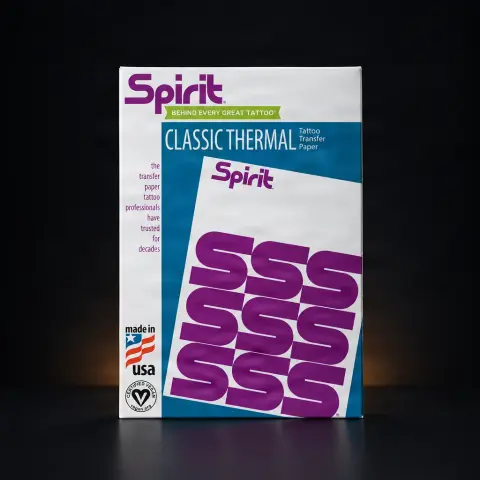
Stencil paper for transferring designs onto skin
Moral rights vs economic rights — what you can sign away and what you can't
Law 8/1996 splits rights into two categories with entirely different rules.
- Moral rights: authorship of the work, the right to your name/signature on it, the right to the work's integrity, the right to decide if and how it's made public. These are non-transferable — no contract can sign them away, no matter what it says.
- Economic rights: the right to reproduce, distribute, publicly display, or commercially use the design. These CAN be assigned by written contract, fully or partially, exclusively or not.
In practice: even if you sign over commercial-use rights to a client or a brand (merch, print, ads), you remain the recognized author of the piece — that part can never be transferred away.
How to prove a design is yours
The law doesn't require registration for protection to exist, but in a dispute you need to prove priority — that you created the design first, on a specific date. A few practical, low-cost steps:
- Keep the source files (digital sketch, PSD, process photos) with intact creation metadata — not just the final export.
- Publish the design with a visible signature or watermark on your own channels, with a clear posting date.
- Email the original, unopened file to yourself — the email's timestamp serves as a time marker.
- For higher-stakes commercial work, consider a certified timestamp (notary, registered mail with declared contents) or a voluntary deposit with ORDA (Romania's copyright office).
- Keep intermediate sketches and client correspondence — they show the creative process, not just the finished result.
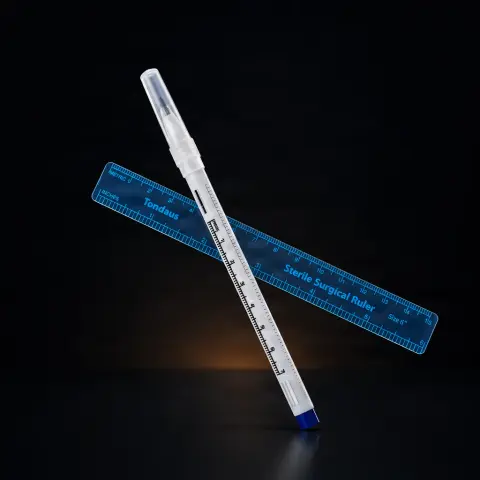
Markers and tools for sketching designs
What you can legally do if someone copies your design
You've spotted your own design tattooed by another artist, or reposted on Instagram with no credit. Steps, in increasing order of intensity:
- Document it: dated screenshots, links, a direct side-by-side comparison between the original and the copy.
- Direct contact first: sometimes it's a misunderstanding or a good-faith repost missing attribution — a polite ask to credit the source or remove the post resolves a lot of cases.
- Platform report: Instagram, Facebook, and Pinterest all have copyright infringement report forms that typically lead to content removal.
- Written notice: through a lawyer or directly, demanding the use stop and, if warranted, compensation.
- Civil action: you can go to court to demand the infringement stop and claim damages for the harm suffered.
- Criminal complaint: if someone claims your work as their own creation, that can constitute a criminal offense under Article 141 of Law 8/1996.
Under Article 141 of Law 8/1996, wrongfully claiming authorship over someone else's work, in whole or in part, and presenting it as one's own intellectual creation, is punishable by 6 months to 3 years in prison or a fine. Beyond criminal liability, these acts can also trigger civil liability (damages) or contraventional sanctions. For a firm decision on how to proceed in a specific case, consult a lawyer specialized in intellectual property.
Flash vs custom — the rules differ
A flash design (pre-drawn, available to multiple clients) stays the property of the artist who created it and can be tattooed on several people without any copyright issue, as long as you haven't promised exclusivity to a client. A custom design, made specifically for one client, is a different conversation: if you promised exclusivity (explicitly, or implied by the "custom" label of the service), tattooing the same design on someone else can be a contractual problem toward that client — separate from the copyright question itself, which stays with you as the artist either way.
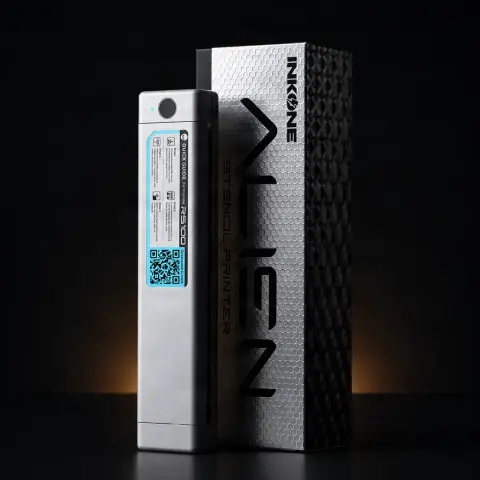
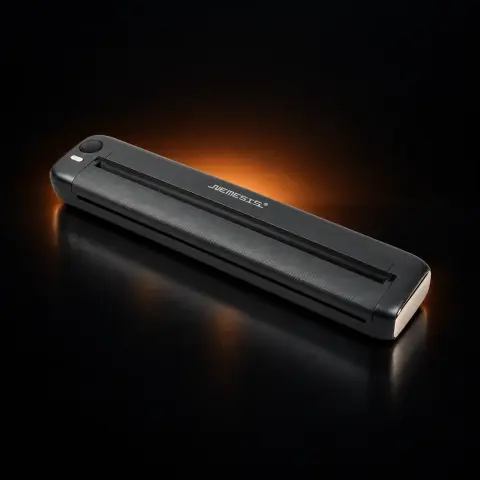
Printers and supplies for tattoo stencils
The client contract clause that protects you long-term
The simplest way to avoid future conflicts is a written consent form/contract, signed before the session, that spells out ownership explicitly. It doesn't need to be legally complex — a few clear lines solve 90% of future disputes.
- State explicitly that copyright in the design stays with the artist, unless there's a separate written assignment.
- Clarify what the client can do with the tattoo image (personal social posts — generally implicitly fine) versus what they can't (commercial use, reselling the design, launching merch based on it).
- If a brand or another studio wants to license one of your designs for commercial use, treat that separately, through an assignment contract with clearly set compensation — proportional to exploitation revenue, a fixed sum, or another agreed formula.
Browse stencil and sketching supplies →
Surse și referințe
- Law 8/1996 on copyright and related rights — Portal Legislativ (official)
- Law 8/1996 — full text, Chamber of Deputies (cdep.ro)
- Law 8/1996, updated 2026 — Lege5.ro
- Contraventions regulated by Law 8/1996 — JURIDICE.ro
- Plagiarism and copyright infringement — JURIDICE.ro
- Romanian Copyright Office (ORDA) — official site
Întrebări frecvente
If a client pays for a custom design, does the design become theirs?+
Not automatically. The client buys the right to wear that tattoo on their own skin, not the copyright to the drawing. Without an explicit written assignment, the economic rights (commercial use, reproduction elsewhere, resale) stay with the artist.
Do I need to register my designs with ORDA for them to be protected?+
No. Copyright protection exists automatically from the moment the work is created, with no registration or deposit formality required. A deposit with ORDA or a certified timestamp can help as proof of priority in a dispute, but neither is a condition for the right to exist.
Can I tattoo a design I saw on Pinterest or Instagram if I tweak it slightly?+
Risky. If the composition, lines, and concrete details of the original work are recognizable, a minor tweak doesn't take you out of infringement territory. You can use an image as a reference for the idea or theme, but the execution needs to be your own original interpretation, not a lightly altered copy.
What do I do if another tattooer copies my design exactly and posts it as their own?+
Document the case (dated screenshots, links, a direct visual comparison), try direct contact first, then report it on the platform (Instagram/Facebook have copyright infringement report forms). If it persists, a written notice and, if needed, a civil action or a criminal complaint (Article 141 of Law 8/1996) are the next steps — best done with guidance from an IP lawyer.
Can I reuse a flash design on multiple clients?+
Yes, a flash design stays your property as the artist and can be tattooed on multiple people, as long as you haven't promised exclusivity to a specific client. That's exactly the difference from a custom design — flash is inherently reusable by nature.
If I work as an employee at a studio, who owns the rights to the designs I create?+
In principle, the economic rights stay with you as the author, even as an employee, unless your individual labor contract explicitly says otherwise. Check the exact wording in your contract — a vague clause can change the outcome in a conflict with the studio.