
Duty Cycle on Power Supplies: What the Number Means and Why Your Machine Cares
Most power supply listings show voltage range, amperage, and maybe a display resolution — duty cycle rarely gets a line, and when it does, nobody explains what the percentage actually controls. It's not a marketing number. It tells you whether the supply can hold your set voltage steady for a four-hour sitting or whether it starts drifting once the internal components heat up.
Duty cycle is the one spec on a tattoo power supply datasheet almost nobody explains — here's what it actually measures and why it decides how stable your machine stays deep into a long session.
What duty cycle actually measures
Duty cycle is a ratio, expressed as a percentage, between how long a power supply can deliver its rated output continuously and how long it needs to rest (or run at reduced output) to avoid overheating internal components — mainly the transformer or switching regulator and any voltage-regulation circuitry. A 100% duty cycle rating means the unit is built to hold its rated output indefinitely without derating. Anything below that means the manufacturer expects the supply to need a cooldown window at some point during continuous use.
This concept is borrowed from welding and industrial power electronics, where a 100% duty cycle machine can run all day and a 60% duty cycle machine needs to rest 40% of the time at full load. Tattoo power supplies work on the same physics — they just rarely spell it out on the box.
Why not every supply lists the same figure
Cheaper switching power supplies often use smaller transformers, minimal heat sinking, and no active cooling, which caps how long they can hold full output before internal temperature forces the voltage to sag or the unit to cut out. Higher-end digital supplies built for continuous professional use typically spec out closer to 100%, because they're designed with larger components and better thermal management specifically so the rated voltage doesn't drift over hours of work.
Plenty of budget supplies simply don't publish the number because it was never tested to a standard. That doesn't confirm the unit is unstable, but it means you're buying without that piece of information. If a session-length stability claim matters to your buying decision, ask the seller directly for the duty cycle spec or an equivalent continuous-run rating before you commit.
What actually happens during a long session
- The voltage reading on the display can drift downward even though you never touched the dial, because internal components warm up and output regulation loosens.
- Line consistency can degrade mid-session — not because your hand technique changed, but because the machine is running on a slightly different voltage than when you set up.
- Some units apply automatic thermal throttling and drop output on their own to protect the circuitry, which shows up as a sudden, unexplained loss of power.
- In the most affected units, sustained continuous use can trigger a full shutdown until the unit cools, which is obviously the worst-case timing during client work.
How to check duty cycle before you buy
- Look for the spec explicitly on the product page or datasheet — search for "duty cycle", "continuous operation", or "continuous duty" rather than assuming a high amperage rating implies it.
- If it's listed as a percentage below 100%, check whether a rest interval is specified alongside it (e.g. run time vs. cooldown time) — that tells you how the number translates into real studio hours.
- For supplies with no published figure, ask the seller whether the unit has been tested for multi-hour continuous output, and at what voltage/current combination.
- Cross-check against your actual working style — if you regularly do multi-hour sittings at higher voltage for shading or coloring, a supply without a continuous-duty rating is a bigger risk for you than for someone doing short outline sessions.
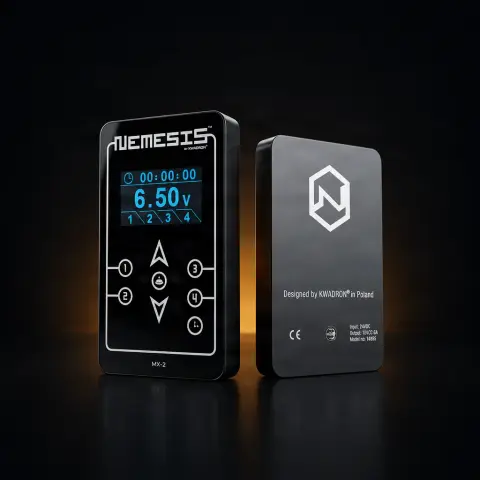
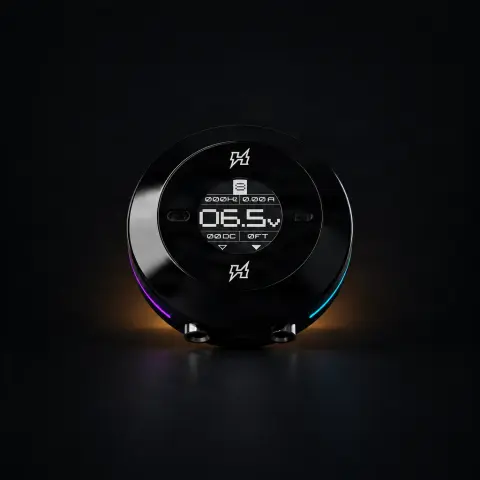
Digital power supplies with voltage adjustment

Does it matter differently for coil vs. rotary machines?
Coil machines are more sensitive to voltage drift because their timing and hit depend directly on a stable voltage feeding the coils — a slow drift changes how the machine hits without you adjusting anything. Rotary machines are generally more forgiving of small voltage shifts since the motor speed response is smoother, but they still depend on the supply holding output steady, especially at the higher end of the voltage range some rotaries need for heavier line or shading work. Either way, a supply with a low or unlisted duty cycle is a variable you're introducing into an already technical setup.
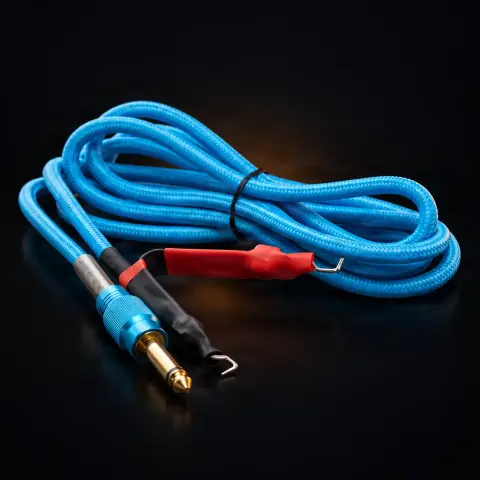
Foot pedals and clip cords for power supplies
Browse power supplies with published continuous-duty specs →
Întrebări frecvente
Is a low duty cycle power supply unusable for tattooing?+
Not necessarily — for short sessions or outline-only work where the supply isn't under continuous full-output load for hours, a lower duty cycle unit can perform fine. The risk grows with session length and with how close to the unit's rated output you're running.
Why don't more manufacturers publish this number?+
Testing continuous-duty performance to a standard takes extra engineering and validation time, and it's not a spec most buyers ask about, so budget suppliers often skip it. It's a gap in the market's transparency, not proof the units are unsafe.
Can I test duty cycle myself before a real session?+
You can get a rough sense by running the supply at your typical working voltage for the length of your longest usual session and watching whether the display voltage stays put or drifts. It's not a lab-grade test, but it will surface an obvious problem before you're mid-session on a client.
Does a higher price always mean a better duty cycle rating?+
Generally higher-end digital supplies invest in duty cycle performance because it's part of what professional buyers expect, but price alone isn't a guarantee — check the actual spec sheet rather than assuming from cost.
Does duty cycle affect amperage output too, or just voltage?+
Both can be affected. As internal components heat up under sustained load, some supplies protect themselves by reducing either voltage, current, or both — which is exactly why the rated duty cycle matters more than the peak numbers on the box.
Is duty cycle the same thing as wattage rating?+
No. Wattage tells you the maximum power the unit can output at a given instant; duty cycle tells you how long it can sustain that output before it needs to back off. A supply can have an impressive peak wattage and still have a mediocre duty cycle.