
Ear Lobe Stretching Kits: Tapers, Size Order, and Wait Times Between Gauges
A lobe stretching kit looks straightforward — a set of tapers with increasing diameters — but the order and pace you use them in decide whether you end up with healthy stretched lobes or a blowout and permanent scarring. This guide covers the standard gauge progression from 14G up, how long to wait between sizes, which taper materials actually matter, and — most importantly — when to stop. The information below is general; a professional piercer's direct evaluation of your own piercing still matters.
A practical breakdown of safe gauge progression from 14G, taper materials, and the warning signs that mean you should stop and downsize.
How a taper kit works
A taper kit is a set of cone-shaped rods, each slightly wider than the last, used to gradually widen a lobe piercing that's already fully healed at its current size. The taper is inserted through the existing hole and, with an insertion taper, pulls the new jewelry through behind it in one motion. Sizes are measured in gauge (G): the lower the number, the bigger the diameter.
- 14G (1.6 mm) – the standard size for a fresh initial lobe piercing, fully healed
- 12G (2 mm)
- 10G (2.5 mm)
- 8G (3 mm)
- 6G (4 mm)
- 4G (5 mm)
- 2G (6 mm)
- 0G (8 mm)
- 00G (10 mm)
- Past 00G, sizes are given directly in mm: 12 mm, 14 mm, 16 mm, 19 mm, 22 mm and so on
Go up one size at a time, never skip a step. Skipping a size is the single biggest cause of blowouts — risk scales directly with how much diameter you force at once, regardless of how 'loose' the lobe feels.
How long to wait between sizes
The general industry guidance is a minimum of 6-8 weeks between each lobe size, and that window gets longer once you're past 8G/3mm, because the tissue is under more tension and needs more time to stabilize. The reason is biological: collagen in the fistula wall (the piercing channel) remodels from disorganized scar tissue into organized, load-bearing fiber over roughly 3-8 weeks. Force a new size before that process finishes and the resulting tissue is more scar-like and less elastic — and that damage compounds at every size after it.
Tapers for a gradual progression
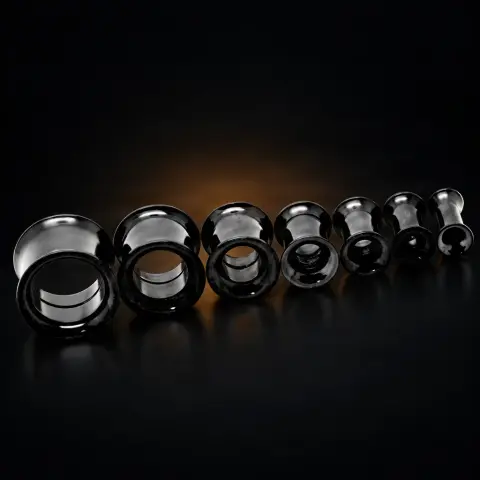
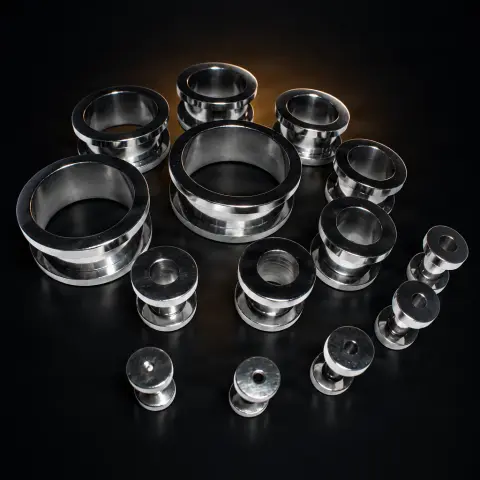
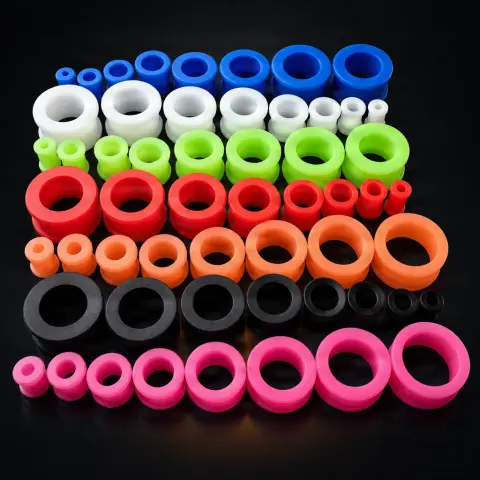
Taper materials: what actually matters
A taper is a temporary tool — it's in the ear for a few minutes while jewelry goes in — so its material matters differently than jewelry worn daily. It still needs to be smooth, with no nicks or porous spots that could irritate freshly stretched tissue.
- Surgical steel or titanium – hard, smooth surface, easy to sterilize; the standard choice for most piercers
- Flexible PTFE (Teflon) tapers – useful for tricky angles or more sensitive lobes, bend without scratching the channel
- Insertion taper/pin attached directly to the jewelry – cuts down the number of passes through the piercing, since taper and jewelry go in as one continuous motion, reducing friction
- Acrylic, wood, bone, horn – avoid for jewelry worn right after stretching, not just for the taper itself: these are hard to fully sterilize and can irritate a freshly widened piercing
When not to force a size
Mild pressure and a stretching sensation are normal for the first few days after a new size. The signs below are not normal and mean you should stop, possibly downsize, and wait longer:
- Sharp or persistent pain, not just pressure
- The skin around the piercing turns pale (blanching) when jewelry is inserted — a sign the tissue is stretched past its limit
- Bleeding when the taper or jewelry goes in
- Skin around the hole looks thinned, translucent, or 'papery' — an early blowout sign
- Local heat, discharge, or bad smell — a possible infection, not simple irritation
- The piercing is recent (under 6-8 weeks since it fully healed) or you've had an unresolved blowout at that size before
A blowout happens when the inner ring of skin in the channel gets pushed outward and doesn't retract — usually the result of moving to a larger size too fast. More stretching won't fix it. Downsize to the last size where the tissue sits flat, restart aftercare as if it were a fresh piercing, and see a professional piercer if it doesn't improve within a few weeks.
Aftercare during the stretching process

A professional piercer can assess your lobe's actual elasticity, recommend a realistic end goal, and safely handle the move into larger sizes (past 00G), where a progression mistake can require surgical repair. This guide is general information; it doesn't replace a direct look at your own piercing.
Browse tapers and stretching jewelry →
Surse și referințe
Întrebări frecvente
How long does the whole path from 14G to 00G take?+
With a minimum 6-8 week wait between sizes and 9 steps between 14G and 00G, the process takes at least 14-18 months. Past 00G, recommended wait times get longer, so total time varies a lot person to person.
Can I skip a size if my ear feels ready?+
It's not recommended. Skipping a size is the leading cause of blowouts, no matter how loose the lobe feels to the touch — actual tissue elasticity isn't something you can judge from the surface.
Is acrylic jewelry okay during stretching?+
Not for a freshly widened piercing. Porous or hard-to-sterilize materials (acrylic, wood, bone, horn) are better saved for once the piercing has fully stabilized at that size.
What do I do if I got a blowout?+
Downsize to the last size where the skin sat flat, restart an aftercare routine as if it were a new piercing, and give it more healing time before trying again. If it doesn't improve, have a professional piercer assess it.
Should stretching hurt if it's done right?+
Mild pressure and a stretching sensation are normal for the first few days. Sharp pain, bleeding, or blanching skin are not normal and mean the size was forced.
What's the difference between a plain taper and an insertion taper (with a pin)?+
A plain taper comes out of the ear before you insert the jewelry, so the piercing goes through two separate passes. An insertion taper is attached directly to the end of the jewelry, so the taper and jewelry go in as one continuous motion, reducing friction.