
Perichondritis: The Serious Ear Cartilage Infection After Piercing — How to Spot It and Why You Shouldn't Wait
A fresh cartilage piercing (helix, tragus, conch, rook, daith) is almost always a bit red and tender for a few days — that's normal. The problem starts when redness spreads, pain gets worse instead of better, and the ear thickens: that's no longer irritation, it's a possible cartilage infection that can progress fast toward permanent deformity. This guide explains exactly what differs, and why with cartilage, how fast you react matters more than with any other piercing. It doesn't replace a medical consult — it's here so you know precisely when you need one urgently.
The real difference between mild, normal swelling after a cartilage piercing and perichondritis — an infection that can destroy the cartilage within days if you don't see a doctor.
What perichondritis actually is
Perichondritis is an infection of the perichondrium — the thin membrane wrapping the ear cartilage that supplies it with blood and nutrients. It occurs almost exclusively after piercings placed through cartilage (helix, tragus, conch, rook, daith, industrial), not the earlobe, which is soft tissue, well supplied with blood, and heals far more easily and quickly.
Why cartilage is a different story than the lobe
Cartilage has very few blood vessels of its own; oxygen and nutrients reach it almost entirely through the perichondrium. When the perichondrium gets infected, blood supply to the cartilage drops, and antibiotics struggle to reach the site. An infection that would resolve on its own or with basic local care in the lobe can, in cartilage, kill the tissue (necrosis) within just days if it isn't treated.
Normal healing vs. a real infection — how to tell them apart
A fresh cartilage piercing is almost always red, mildly swollen, and tender for the first few days — that's normal healing, not infection. The signs below help you tell the difference.
- Redness confined strictly to the piercing hole, not the whole ear
- Small, stable swelling that doesn't visibly grow day to day
- Clear or whitish discharge that dries into a thin crust (lymph, not pus)
- Tenderness that steadily improves over the first 1-2 weeks, not worsens
- Pain that increases day over day instead of settling down
- Redness and localized warmth spreading beyond the hole, across the whole cartilage area
- Swelling that makes the ear feel thickened, firm, or misshapen on touch
- Yellow or greenish discharge with a foul smell, or visible pus
- Pain out of proportion to touch, including in areas around the piercing
- Fever, chills, or feeling generally unwell
If you notice any of: rapidly spreading swelling, cartilage that's hard and hot to the touch, pus, fever, or pain that hasn't eased within 48 hours, don't wait to see if it 'goes away on its own.' Untreated perichondritis can permanently destroy the cartilage within days.
Why Pseudomonas is almost always the suspect
The organism most commonly identified in piercing-related perichondritis is Pseudomonas aeruginosa, a bacterium that thrives in moist environments and doesn't respond to the 'usual' antibiotics used for simple skin infections. That's why an over-the-counter antibacterial ointment kept at home isn't sufficient treatment — a doctor typically needs to prescribe a systemic antibiotic active against Pseudomonas (a fluoroquinolone such as ciprofloxacin, for example), not just a topical cream. Staphylococcus aureus shows up less often, but it's still possible.
What happens if you wait
Left untreated, the infection can form an abscess that cuts blood supply to the cartilage even further. Dead cartilage doesn't regenerate — the result can be a permanent deformity commonly known as cauliflower ear, which is hard to correct even with reconstructive surgery. The window matters: the faster you get to a doctor, the better your odds of healing without lasting damage.
What to do right now, step by step
- Don't self-treat with rubbing alcohol, hydrogen peroxide, or harsh disinfectants on the area — they further irritate an already inflamed perichondrium.
- Don't remove the jewelry yourself if you suspect a real infection, unless a doctor explicitly tells you to — timing matters for how the infection progresses.
- Don't press, squeeze, or manipulate the area to 'get the pus out.'
- See a doctor — an ENT, your GP, or urgent care/ER if you have fever or severe symptoms — as soon as possible, ideally within 24-48 hours of warning signs appearing.
- Explicitly mention it's a cartilage piercing, so Pseudomonas is considered from the start, not just the usual bacteria.
- Finish the full course of treatment even if symptoms improve quickly — stopping antibiotics early raises the risk of recurrence.
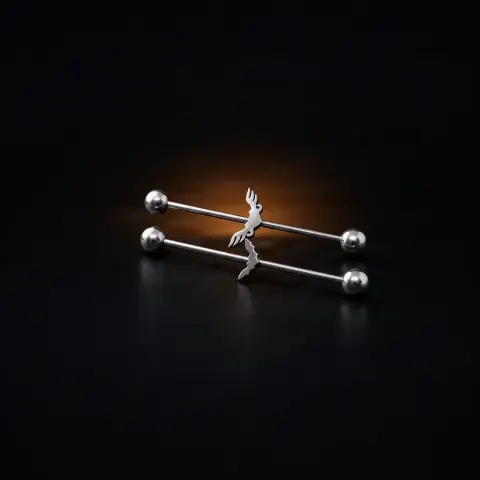
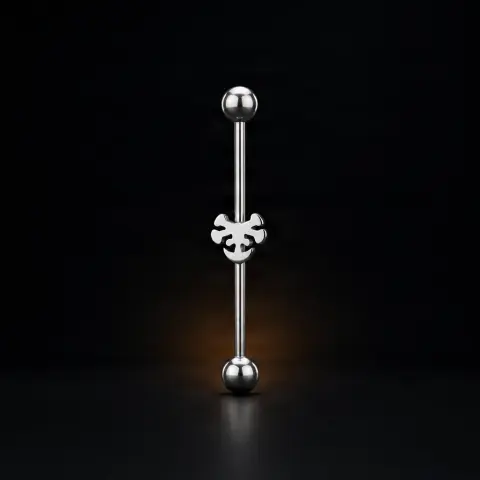
Jewelry for cartilage piercings


How to prevent perichondritis on a new piercing
Most of the risk gets decided at the moment of piercing itself, not afterward.
- Ask for a sterile, single-use needle, not a piercing gun — guns apply blunt force to cartilage and can't be fully sterilized between clients, which raises both infection and tissue-trauma risk.
- Check the jewelry: implant-grade titanium or quality surgical steel, nickel-free, to reduce irritation that can mask or encourage an infection.
- Don't touch a new piercing with unwashed hands, and avoid sleeping directly on it for the first few weeks.
- Clean with sterile saline, not alcohol or hydrogen peroxide, which dry out and irritate the perichondrium.
- Avoid pools, saunas, and untreated water during initial healing.
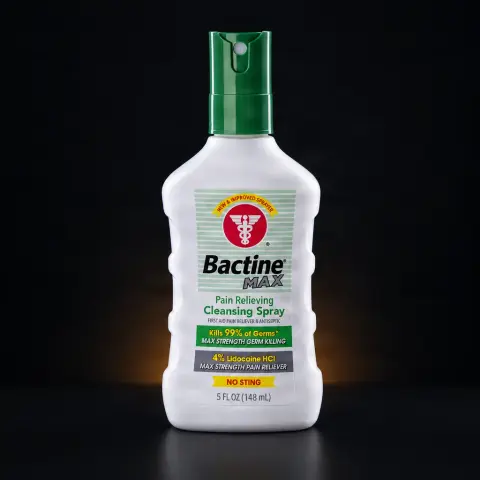
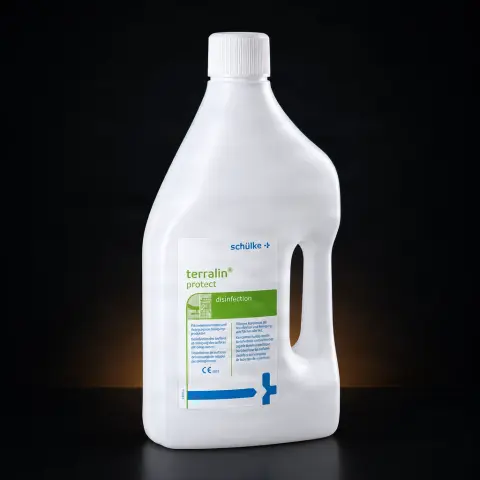
Piercing disinfectant spray

Looking for the right cartilage piercing supplies? →
Surse și referințe
- Cleveland Clinic — Perichondritis: Symptoms, Causes & Treatment
- StatPearls (NCBI Bookshelf) — Pinna Perichondritis
- PMC — Auricular perichondritis by piercing complicated with pseudomonas infection
- GOV.UK — Pseudomonas aeruginosa perichondritis associated with ear piercings (guidance for piercing businesses)
Întrebări frecvente
Can the earlobe get perichondritis too?+
Very rarely. The lobe is soft tissue with good blood supply and heals fast. Perichondritis occurs almost exclusively in cartilage piercings (helix, tragus, conch, rook, daith), where blood vessels are scarce and infection is much harder for the body to fight.
How soon after piercing can symptoms appear?+
Signs can show up anywhere from a few hours to a few weeks after piercing, but they most commonly become clear within the first several days to a week. Any worsening — not just the presence of redness — is the important signal.
Should I remove the earring myself if I suspect perichondritis?+
No, not without medical guidance. Whether and when to remove the jewelry is a call for the treating doctor — removing it incorrectly can worsen or mask the infection and complicate treatment.
Is an over-the-counter antibiotic ointment enough?+
Usually not. The main suspect, Pseudomonas aeruginosa, typically needs a systemic antibiotic (oral or IV) prescribed by a doctor, not just topical treatment. A generic ointment can delay proper diagnosis without stopping the infection.
What is 'cauliflower ear'?+
It's a permanent deformity of the ear cartilage caused by untreated necrosis — dead cartilage collapses and thickens irregularly. It's difficult to fix even with reconstructive surgery.
Does it matter if the piercing was done with a gun or a needle?+
Yes. Piercing guns apply blunt force to cartilage and, unlike a sterile single-use needle, can't be fully sterilized between clients — both factors raise the risk of tissue trauma and cartilage infection.