Complete guide: Cheyenne Capillary Cartridge Needle SHADER (RS)
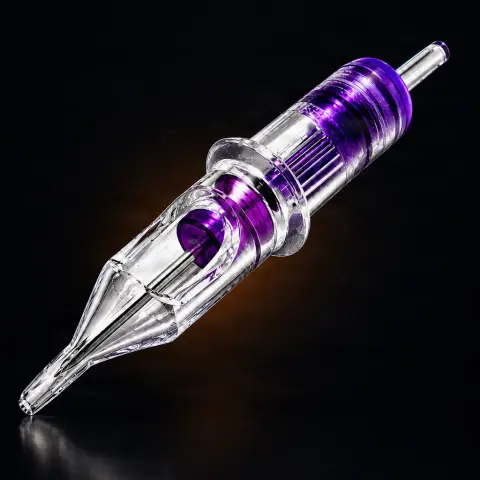
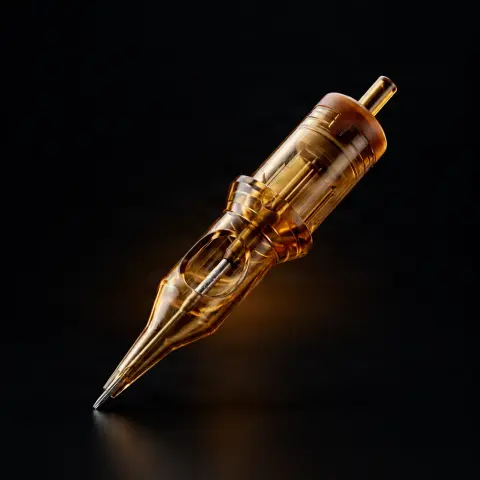
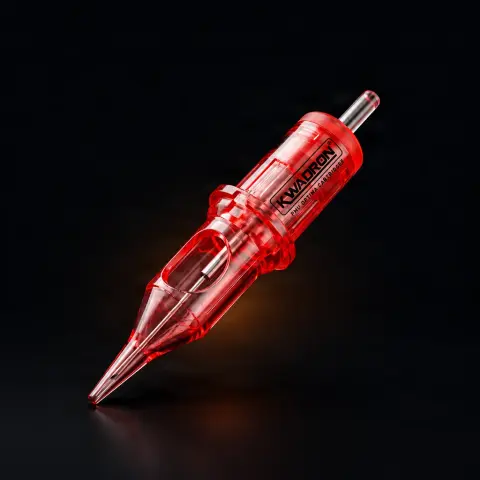
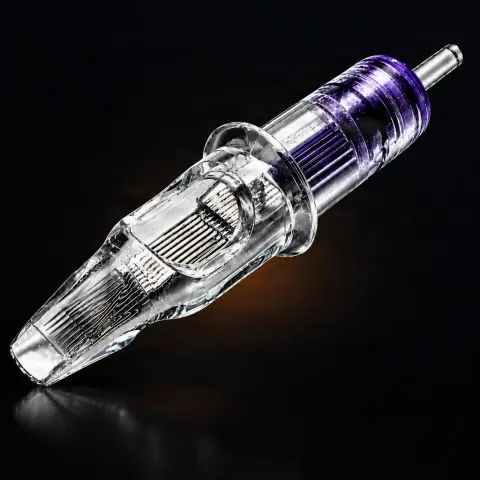
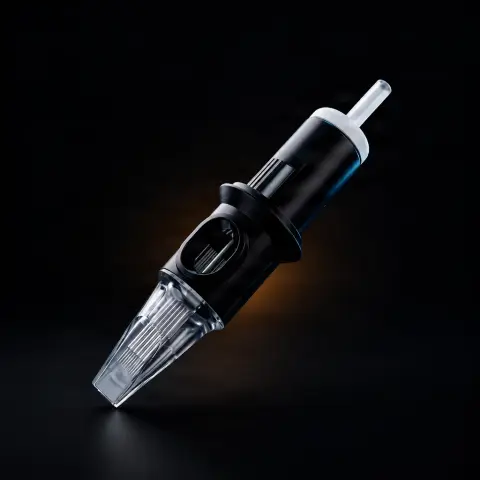
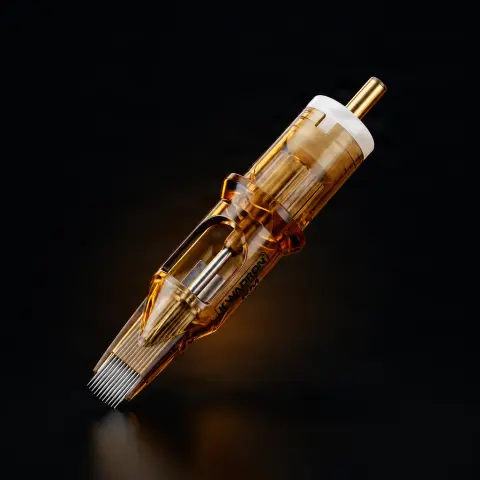
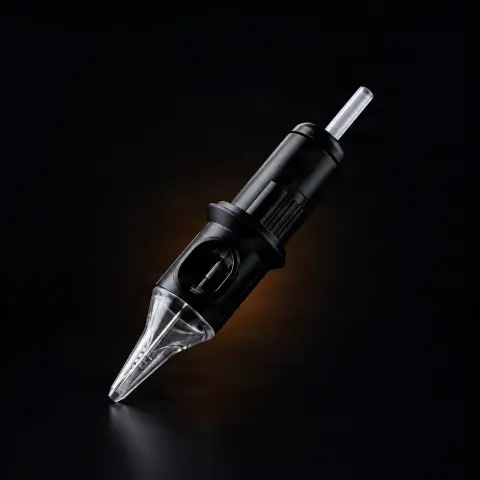
This is a disposable needle cartridge from the Capillary range by manufacturer Cheyenne, in Round Shader (RS) configuration — needles grouped circularly, designed for shading and small fill-ins. The difference from conventional cartridges is the capillary reservoir system in the tip, which holds approximately 10 times more ink and distributes it evenly across all needles. It is sterile packaged, manufactured according to medical standard ISO 13485, and is aimed at both experienced artists and those already working on a cartridge system who want a more consistent ink flow.
How to use
- Check the sterile packaging before use: if the blister is damaged, punctured, or opened, do not use the cartridge.
- Prepare a hygienic work station: disposable gloves, protective barriers on the machine and on surfaces touched during work.
- Remove the cartridge from the packaging without touching the tip and secure it in the machine or grip compatible with the Cheyenne cartridge system until it clicks firmly into place.
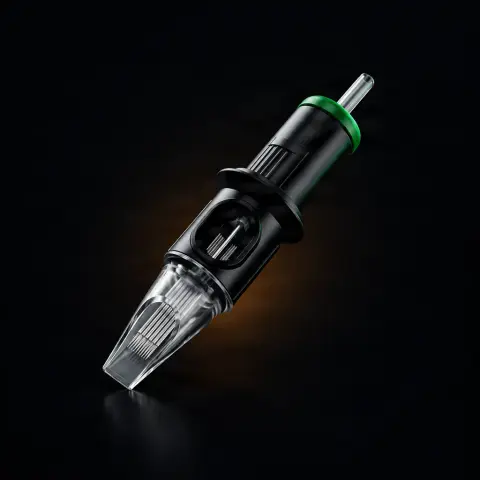
- Quickly identify the configuration by the colored cap on the bottom of the cartridge — the color coding system is exactly for this purpose.
- Adjust the needle protrusion according to your technique and start the machine for a short test before touching the skin.
- Dip the tip into the ink cup: the capillary reservoir absorbs more ink than a regular cartridge, so you will return to the cup less often and can work longer shading passages without interruptions.
- Work the shading with your usual movements; the even distribution of ink across all needles helps with consistent surface filling, with fewer repeated passes over the same area.
- At the end of the session, remove the cartridge and immediately dispose of it in a dedicated sharps container — it is a disposable product.
Tips from us
- Choose the RS configuration suitable for the area: round shaders are most useful for shading in small and medium spaces, transitions, and textures; for large areas, a magnum usually remains the more efficient choice.
- Take advantage of the capillary reservoir: fewer returns to the ink cup means a more consistent work rhythm and fewer passes over the skin, hence less trauma for the client.
- The patented safety membrane prevents blood and ink from entering the handle, but it does not replace hygiene: reusable grips still need to be cleaned and sterilized after each client.
- Order considering that the price is per piece — calculate your needs per session and always keep a few sealed spare cartridges.
- Store the cartridges in their original packaging, in a clean and dry place, away from moisture and contact with dirty surfaces.
Warning: Disposable product, sterile packaged: do not reuse and never attempt to re-sterilize a cartridge that has been unsealed or used. Handle it only with gloves, on a station prepared with protective barriers, and dispose of it after use in a sharps container, according to regulations for tattoo studios. The sealing of the safety membrane complies with the requirements of European standard EN 17169, and the manufacturing follows medical standard ISO 13485 — but the responsibility for session hygiene remains with the artist. Do not use cartridges with damaged packaging or expired.
Frequently asked questions
What does 'SHADER (RS)' mean and what is it used for specifically?▾
RS stands for Round Shader: the needles are grouped circularly, with an arrangement designed for shading, not lines. In practice, a round shader is used for shading in small and medium areas, spot fills, transitions, and textures — where a liner would be too 'sharp' and a magnum too wide. If you primarily do linework, instead look for liner-type configurations in the same range.
Which machines is this cartridge compatible with?▾
Being a Cheyenne cartridge, it is built for the Cheyenne cartridge system — it works with Cheyenne machines and generally with pen-style machines that accept cartridges compatible with this system. The vast majority of modern rotary cartridge machines use this standard, but check in your machine's specifications that it accepts Cheyenne-type cartridges before ordering in bulk.
How is the Capillary system different from a regular cartridge?▾
Inside the tip there is a capillary reservoir, thanks to which the cartridge retains approximately 10 times more ink than a conventional cartridge. The ink is distributed evenly across all individual needles, even in large configurations, so surfaces fill consistently and quickly, with fewer repeated passes — which means less trauma to the client's skin. Additionally, the needle guidance is improved, for greater precision.
Can I reuse the cartridge on another client if I disinfect it well?▾
No, under no circumstances. It is a disposable product, delivered sterile, and cannot be properly re-sterilized in studio conditions — the risk of cross-contamination is real. After each session, the cartridge is disposed of in the sharps container. The patented safety membrane protects the handle from blood and ink during work (sealing according to EN 17169), but that does not make the cartridge reusable.
I am a beginner — does it make sense to start directly with these cartridges?▾
You can, if you work on a machine compatible with the Cheyenne system: the cartridges are 100% quality-controlled under microscopic inspection, and the constant ink flow more easily forgives small rhythm inconsistencies of a beginner in shading. However, keep in mind that the price is per piece, so for practice on synthetic skin many prefer cheaper consumables and save the premium cartridges for real work.
How can I quickly tell what configuration I have in hand during the session?▾
The cartridges have colored caps on the bottom, specifically for easy identification of the needle configuration. If you work with multiple configurations on the same piece, organize them on the station by color, with the packaging sealed until the moment of use — open each cartridge only when you actually reach that stage.
Product description
Cartridge needles Cheyenne Capillary needles are revolutionary because they retain 10 times more cough than those conventional cartridges. They have an improved needle guidance that allows much greater precision. Inside the tip of the cartridges there is a capillary with a reservoir, therefore these cartridges absorb more cough. Cheyenne Capillary needles ensure uniform distribution of the cough on all individual needles, even in large needle configurations such as the magnum ones. As a result, the work surfaces are filled constantly, reliably and above all quickly, which means less trauma for the client's skin. The needles are 100% passed through microscopic quality control. In the lower part of the needle, they have colored caps, for easier identification of the needle configuration. The needles have a patented safety membrane that prevents blood and cough from entering the handle. The sealing of the membrane complies with the requirements of the European standard EN 17169Cheyenne Capillary are needles manufactured according to medical standards (ISO 13485)Material: Stainless steel Single-use product, sterile packaged The price is per piece
Cheyenne Capillary SHADER (RS) cartridge needles bring Cheyenne's patented capillary system to the Round Shader configuration, creating the supreme instrument for precision shading and artistic-level pepper shading. The capillary technology ensures constant ink feeding through natural capillary forces, eliminating the flow fluctuations that affect traditional membrane cartridges. The RS configuration arranges needles in a circular formation with controlled spacing, providing a perfect round contact area for gradual ink deposition in small and medium zones. This combination makes Capillary RS the ideal cartridge for texturing in realism portraits, shading in tight spaces, delicate transitions, and pepper shading techniques requiring absolute control of every pigment drop. Manufactured entirely in Germany from premium surgical steel with microscopic-level polishing, each needle grouping is individually inspected. Gamma sterilization — the superior medical standard leaving no chemical residues. Compatible with all Cheyenne machines and most universal pen-style machines. Compared to Kwadron RS, Capillary offers superior ink flow at a premium price. Against Big Wasp X RS, Capillary RS is in a superior class of consistency — every cartridge feels identical to the previous one. Against Cheyenne Safety RS, the Capillary advantage is evident in long-duration pepper shading where flow constancy is critical. Available from 3RS through 9RS. Box of 20 cartridges. The choice of the most demanding artists for precision shading.
Frequently Asked Questions What advantage does the Cheyenne capillary system offer for round shader? The Cheyenne capillary system provides a decisive advantage for round shader: constant ink flow at any speed or working angle. In the RS configuration, where each contact point matters for subtle textures, the capillary flow consistency eliminates overly light or dark spots that occur with traditional membranes. The result is pepper shading with uniform density and impeccable gradients, even after hours of continuous work. Is Cheyenne Capillary RS compatible with FK Irons Xion? Yes, Cheyenne Capillary RS works perfectly with FK Irons Spektra Xion. The cartridge fits the standard grip without compatibility issues. On Xion, set stroke to 2.5-3.0mm for fine pepper shading and 3.0-3.5mm for more aggressive shading. Optimal voltage on Xion is 0.3-0.5V higher than on Sol Nova. The Xion + Capillary RS combination is very popular among realism artists due to Xion's powerful motor and Capillary's constant flow. What RS Capillary configurations are available? Cheyenne Capillary Shader RS is available in 3RS, 5RS, 7RS, and 9RS configurations. 3RS is for ultra-fine texturing and micro-details in realism portraits. 5RS is the most versatile — ideal for general pepper shading, delicate transitions, and small areas. 7RS covers medium areas with good efficiency. 9RS is for denser shading in areas where a magnum is not needed. All come exclusively in #12 gauge (0.35mm). Recommendation: stock 5RS as your essential base. What voltage works best for Cheyenne Capillary RS? Optimal voltage for Capillary RS is between 5.5-8V, depending on technique. For fine pepper shading with 3RS: 5.5-6.5V — very low voltage for maximum control. For standard shading with 5RS: 6.5-7.5V. For denser shading with 7RS-9RS: 7-8V. The capillary system allows working at lower voltages than conventional cartridges, meaning less skin trauma. On Sol Nova, testing shows that 6.5V on 5RS Capillary equals approximately 7.5V on a conventional 5RS. Can I use Cheyenne Capillary RS for stippling / dotwork? Yes, Cheyenne Capillary RS works excellently for stippling and dotwork, especially in the 3RS configuration. The capillary system ensures constant ink deposition at each point, eliminating density variations that can occur with conventional cartridges. Use low voltage (5-6V), rapid perpendicular movements, and lift the machine completely between points. Result: perfect dots, uniform, identical in size and density. For classic single-point dotwork, Capillary RL 1RL remains superior, but 3RS Capillary creates unique and natural dot clusters. What is the price difference between Capillary RS and Safety RS? Cheyenne Capillary RS is approximately 20-30% more expensive than Safety RS. On the Romanian market, Safety RS costs around 150-190 RON / 20 pcs, while Capillary RS is between 190-250 RON / 20 pcs. The difference per cartridge is 2-3 RON, negligible relative to session rates. The investment is justified for artists doing realism and pepper shading frequently, where flow constancy makes a visible difference in final quality. For occasional shading or bold styles, Safety RS is sufficient. How does Cheyenne Capillary RS compare to Kwadron RS? Kwadron RS is an excellent premium choice, with superior quality steel and very consistent taper. Cheyenne Capillary RS wins on ink flow — the capillary system provides more constant feeding than Kwadron's membrane, especially in long sessions. Kwadron wins on configuration variety (including #10 gauge) and slightly more accessible pricing. In practice, both are in the world's top 3 for RS. The choice depends on personal preference: capillary (Cheyenne) vs. premium membrane (Kwadron). Test both and decide. Is Cheyenne Capillary RS good for black and grey? Excellent. Cheyenne Capillary RS is one of the best options for black and grey tattoo. The capillary system maintains diluted ink (grey wash) at the same consistency throughout the session, which is critical for uniform tones. With RS Capillary and a set of 4-5 pre-mixed grey washes, you can build B&G portraits with exceptional depth. 5RS is the standard size for general B&G, 3RS for details (eyelashes, pores, hair texture). Recommended voltage: 6-7.5V for progressive tone building. Does Cheyenne Capillary RS require special machine maintenance? No, Cheyenne Capillary RS requires no special maintenance or machine modification. It mounts exactly like any other standard cartridge — insert into grip, secure, and work. The capillary system is integral to the cartridge, requiring no additional parts. The only recommendation: ensure the grip is clean and dry before mounting, and that the machine operates at normal parameters. After the session, dispose of the cartridge in the sharps container and clean the grip per standard disinfection protocol. Can I combine Capillary RS with Capillary RL in the same session? Absolutely, this is the combination recommended by Cheyenne for complete sessions. Start with Capillary RL for outlining, then switch to Capillary RS for fine shading and details. Both using the capillary system, you benefit from the same flow quality throughout the session. Adjust voltage: reduce by 0.5-1V when switching from RL to RS. For even more versatility, add Capillary RM for large-area shading — the RL+RS+RM Capillary triad covers 100% of needs for a complete realism piece.