Complete guide: Cheyenne Safety Cartridge Needle Flat (F)
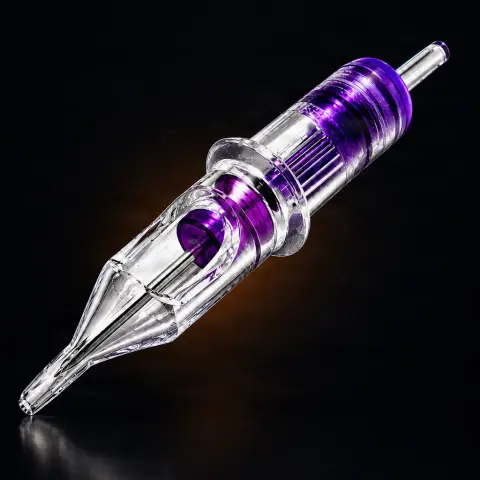
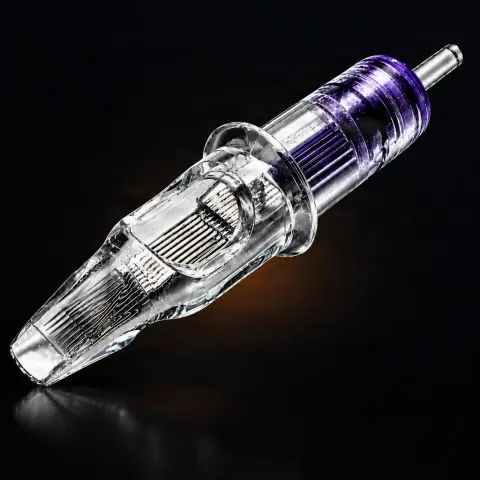
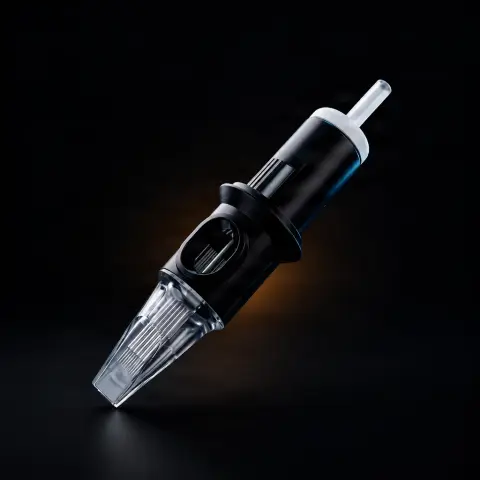
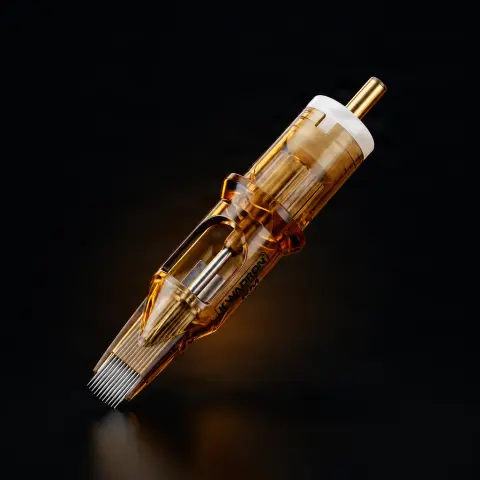
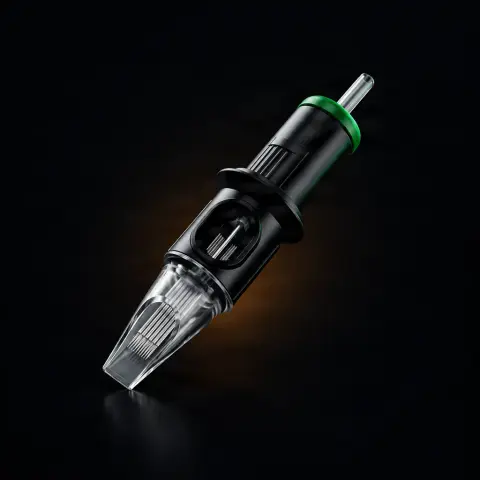
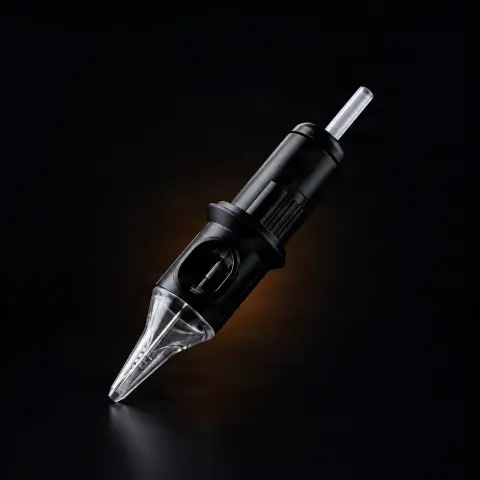
Cheyenne Safety cartridges with Flat configuration are single-use, sterile tattoo needles with needles arranged in a single straight row — designed for wide lines with clean edges, quick fills on straight areas, and linear shading techniques. The patented safety membrane prevents blood and ink from entering the grip, and its sealing meets the European standard EN 17169. They are a niche tool but hard to replace for tribal, geometric, blackwork, and bold lettering — suitable for both experienced artists and those looking to expand their technique palette.
How to use
- Wash your hands, put on disposable gloves, and prepare the work station with protective barriers on the machine, grip, and clip cord.
- Check the cartridge blister: it must be sealed and intact. If the sterile packaging is damaged or expired, do not use the cartridge.
- Remove the cartridge from the packaging without touching the tip and secure it in the grip until it locks properly.
- Adjust the needle protrusion (how far the tip extends from the cartridge) and start at a guiding voltage of 7.5–9 V, which you adjust based on your machine, stroke, and technique.
- Hold the cartridge as close to 90° to the skin as possible: the flat configuration deposits evenly only if all needles touch the skin at the same time — any tilt produces an uneven line.
- For lines, work in a single steady pass; for fills on straight areas, slightly overlap passes while maintaining the same direction.
- Do not reuse or resterilize the cartridge: after the session, dispose of it in a sharps container.
- Finally, remove the protective barriers and disinfect the machine and grip according to your hygiene procedure.
Tips from us
- Choose the size based on the desired line width: small numbers (e.g., 5F) are suitable for lettering, while larger ones for blackwork and massive fills — the higher the number, the wider the line. 7F and 9F are a versatile stock base.
- Use the flat for what it's made for: thick straight lines, tribal, geometric, fills on straight areas. For fine curves or gradients in all directions, an RM or RS remains the better choice.
- Try linear whip shading with a flat: by varying pressure and speed, you get uniform transitions on a single axis, with lines that taper elegantly.
- Check before ordering that your machine or grip accepts the Cheyenne cartridge system — the Safety range is built around this system.
- The price is per piece, so calculate your needs per session and keep reserves of the sizes you use often.
Warning: Cartridges are single-use and delivered sterile — do not reuse or resterilize them under any circumstances. The safety membrane reduces the risk of grip contamination (sealing according to EN 17169), but does not replace standard hygiene: gloves, protective barriers, station disinfection, and disposal of the used cartridge in a sharps container. Do not use a cartridge whose sterile packaging is damaged or expired. Needle production meets the medical standard ISO 13485, and the material is stainless steel.
Frequently asked questions
What does the Flat (F) configuration mean and when should I choose it over an RL or M1?▾
With a Flat configuration, the needles sit in a single straight row, so you get a wide line with clean edges in one pass. An RL (round liner) has needles tightly packed in a circular formation and makes outline lines, while an M1 (magnum) has two staggered rows and covers surfaces for shading and fill. Choose F when you want uniform thick lines — tribal, geometric, bold lettering, blackwork with straight edges — and M1 when you want to shade or cover large areas. They are complementary tools, not competing ones.
Is the cartridge compatible with my machine?▾
Safety cartridges are built for the Cheyenne cartridge system (e.g., Hawk machines) and work on pen-style machines that accept this system. Before ordering, check your machine or grip specifications to ensure they are compatible with Cheyenne cartridges; if you use a different grip system, you may need a dedicated grip or adapter.
What does the safety membrane in the cartridge help with?▾
The patented membrane prevents blood and ink from passing from the cartridge into the grip and further into the machine — its sealing meets the European standard EN 17169. Essentially, it reduces the risk of cross-contamination between clients and protects the equipment. However, note: the membrane does not replace the rest of hygiene — gloves, protective barriers, and station disinfection remain mandatory for every session.
Can I reuse the cartridge if I only used it for a few minutes?▾
No. Cartridges are single-use and sterile-packed, and once used on skin, they cannot be restored to a sterile state in studio conditions. Reusing them means a direct risk of infection and cross-contamination. After the session, the cartridge goes into the sharps container, no matter how little it was used.
What Flat sizes are available and which one should I start with?▾
The Flat range goes from 5F to 15F, in odd numbers. The higher the number, the more needles are on the row and the wider the line. If you're just building your stock, 7F and 9F cover most tribal and geometric work; 5F is useful for lettering, and larger sizes for massive blackwork. Check the product page for available sizes in stock, as they are sold individually.
Can I shade with a flat?▾
Yes, but it's a specific technique: flat shading produces uniform transitions on a single axis — you vary pressure and speed in one pass and get a linear gradient. Whip shading with a flat gives lines that taper nicely. For classic shading with gradients in all directions, an RM or RS remains the right choice.
Product description
Cartridge needles With the Safety cartridges, Cheyenne proves once again its leader in innovation, they represent a milestone in work safety, simplicity and hygiene. The needles come with a patented safety membrane that prevents blood and ink from entering the handle. The tightness of the membrane complies with the requirements of the European standard EN 17169. Experienced experts make sure that the needles are in compliance with medical standards (ISO 13485)Material: Stainless steel The needles are single-use and sterile packaged The price is per piece
Cheyenne Safety Flat (F) cartridge needles represent the flat configuration from Cheyenne's mid-premium Safety range, designed for artists needing thick lines, rapid fills, and special wide-edge lining techniques. The Flat (F) configuration arranges needles in a single straight row, creating a wide line in a single pass — ideal for tribal, bold geometric lines, rapid fills in straight areas, and linear whip shading techniques. The advanced Safety membrane provides excellent ink flow and complete anti-backflow protection. Manufactured in Germany from premium surgical steel, each needle polished at microscopic level. Gamma sterilization — medical gold standard. Taper is calibrated to allow uniform deposition across the full width of the flat configuration. Compatible with all Cheyenne machines and most universal pen-style machines. Compared to Kwadron F, Cheyenne Safety F offers superior flow and German manufacturing. Against Cheyenne Craft, Safety brings the advanced membrane and perfect lot-to-lot consistency. Available from 5F through 15F. Box of 20 cartridges. The F configuration is less common than RL, RS, M1, or RM, but indispensable for certain styles and techniques. Tribal, Polynesian, geometric, and bold lettering depend on flat needles for uniform thick lines. CE compliant, lot traceable.
Frequently Asked Questions What is the Flat (F) configuration and how does it differ from others? The Flat (F) configuration arranges needles in a single straight row, unlike M1 (two staggered rows) or RL (circular formation). Result: a wide, uniform line with clear straight edges. F is ideal for thick lines in a single pass, tribal patterns with geometric edges, rapid fills in straight areas, and wide brush effect. Not suitable for fine curves or gradual shading — for those, RM or RS are superior. F is a specialized tool, not a universal replacement. What styles is Cheyenne Safety Flat ideal for? Cheyenne Safety Flat excels in tribal (Polynesian, Maori, Borneo), geometric/sacred geometry, bold lettering (thick sans-serif fonts), blackwork with straight lines, and ornamental patterns with defined edges. Additionally, some neo-traditional artists use flat for fills in narrow, straight areas. Flat is a niche tool — you will not use it every session, but when you need it, no other cartridge type can replicate the result. What voltage should I run Cheyenne Safety Flat at? Voltage for Cheyenne Safety Flat: 7.5-9V. Flats require slightly higher voltages than RL due to the large number of needles that must penetrate simultaneously. For single lines: 7.5-8.5V. For rapid fills: 8-9V. On Sol Nova with 3.5mm stroke, 8V is a good starting point. Important: maintain a constant 90-degree angle to the skin for uniform deposition across the flat's full width. Any tilt will produce an uneven line. What Flat sizes are available in Cheyenne Safety? Cheyenne Safety Flat is available in 5F, 7F, 9F, 11F, 13F, and 15F. 5F produces a wide line of approximately 2mm. 7F — about 3mm. 9F — about 4mm. 11F — about 5mm. 13F and 15F — very thick lines of 6-7mm. Most popular: 7F and 9F for standard tribal/geometric, 5F for lettering, 11F+ for massive blackwork. Minimum recommended stock: 7F and 9F as your base. Can Cheyenne Safety Flat be used for shading? Yes, but in a specific way. Flats create a particular type of linear shading (flat shading) — uniform transitions on a single axis. By varying pressure and speed in a single pass, you can create a linear gradient. The whip shading technique with flat produces lines that taper elegantly. However, for conventional shading with gradients in all directions, RM or RS are superior. Flat shading is a specialized technique very effective for certain aesthetic effects. What is the difference between Flat (F) and Magnum (M1)? The fundamental difference: F has needles in a single row, M1 in two staggered rows. F produces lines — a thin band of ink with clear edges. M1 produces surfaces — a wide coverage area for shading. F is for thick lining, M1 for shading and fills. Do not confuse them: F at 9 needles produces a wide 4mm line, M1 at 9 needles produces a coverage area of approximately 4mm width on two rows, ideal for shading. They are complementary instruments, not competitors. Does Cheyenne Safety Flat work on FK Irons Xion? Yes, Cheyenne Safety Flat works on FK Irons Xion without issues. Set the Xion stroke to 3.5mm for flats — the longer stroke ensures complete penetration across the full needle width. Recommended voltage on Xion: 8-9V. Xion with its powerful motor is actually one of the best machines for large flats (11F+), providing sufficient force to push all needles simultaneously through skin. Can I use Flat for Polynesian/Maori tattoo? Absolutely, Cheyenne Safety Flat is the essential tool for authentic Polynesian and Maori tattoos. These styles depend on thick, uniform lines with precise geometric edges — exactly what the flat configuration offers. 7F and 9F are most used for standard Polynesian patterns. 11F for dominant thick lines. Combine with RL for complementary thin lines. Constant voltage (8-8.5V), perpendicular angle, and uniform speed are the keys to perfect lines in the Pacific style. Is Cheyenne Safety Flat available with long taper? Cheyenne Safety Flat comes standard with medium taper, optimized for versatility. Long taper is not standard in the Safety Flat range, as flats are predominantly used for defined lines that benefit from direct penetration (medium-short taper). A long taper on flat would reduce line edge definition. If you need flat with gentler penetration for whip shading effect, reduce voltage by 0.5V instead of seeking long taper. How much does Cheyenne Safety Flat cost in Romania? Cheyenne Safety Flat sits between 150-210 RON for a box of 20 cartridges, similar to other Safety range configurations. Price varies slightly by size — larger configurations (13F, 15F) may be slightly more expensive. Being a niche product (lower demand than RL or M1), availability may vary. We recommend ordering from tatuat.ro for the best prices and updated stock.