

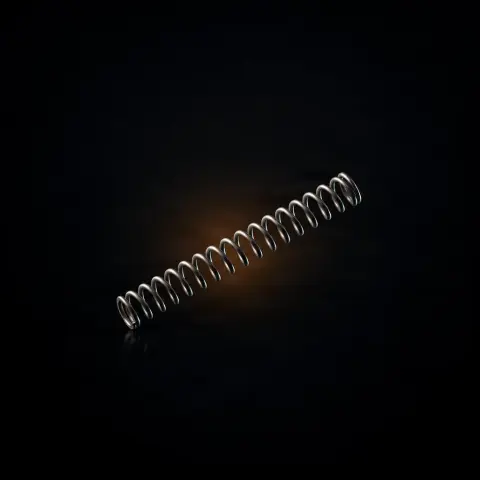
Inkmachines nr. 78 - Inner piston spring Stingray STD - 1pcs
Ink MachinesSpecifications
- Brand
- Ink Machines
- Packaging
- 1 pcs
Useful guides:Piese de schimb Ink Machines — Dragonfly, Stingray, Scorpion, Cobra: ghidInkMachines — mașini suedeze și piese de schimb (Dragonfly, Scorpion, Stingray, Cobra)Întreținerea mașinii de tatuat: piesele de schimb esențiale
Guide & full description
Complete guide: Inkmachines nr. 78 - Inner piston spring Stingray STD - 1pcs
A precision replacement spring for the internal piston mechanism of the InkMachines Stingray rotary machine, in the STD version — intended for traditional (non-cartridge) needles. It is the component that provides the return force, i.e. brings the needle bar back to the retracted position after each penetration cycle; on a piston machine, it fulfills the role that the rubber band has on traditional coil machines, but with a more consistent and adjustable return force. It is aimed at tattoo artists who own a Stingray in STD configuration and want to restore a precise needle return or have noticed the machine has become 'soft', inconsistent, or has started making noise.
How to use
- Turn off and disconnect the machine, then work on a clean surface. Consult the InkMachines manual for steps specific to your model.
- Disassemble the necessary components to access the piston chamber.
- Remove the old spring from its position.
- Place the new spring correctly in the piston chamber.
- Reassemble the disassembled components.
- Ensure the inner piston is lubricated and moves smoothly.
- Adjust the spring stop screw (part no. 77) for the desired preload — tighter means higher return force.
- Test operation on artificial skin before working on a client.
Tips from us
- Check the spring periodically: manually compress and release it — a good spring returns instantly with vigor. If it returns slowly or remains partially compressed, it is a sign of wear.
- If the machine has become 'soft' or noisy but the spring still seems good, first check the piston lubrication and only then adjust the force via the spring stop screw (no. 77).
- The manufacturer mentions that a slightly weakened spring can be stretched by about 2 mm as a temporary solution, but replacement remains the safe long-term option.
- Keep a spare spring in your kit — it is a small part that can wear out during the busy season.
- Choose the configuration that suits how you work: STD for traditional needles, and for cartridges there is a dedicated spring (part no. 79).
- Avoid generic springs: different spring rates and dimensions unpredictably change your machine's behavior.
Frequently asked questions
What actually is part no. 78?▾
It is the internal piston spring for the InkMachines Stingray machine, in STD configuration, i.e. the version for traditional (non-cartridge) needles. Its role is to provide the return force that brings the needle bar back to the retracted position after each penetration. Essentially, it performs the function that the rubber band has on traditional coil machines, but with a more consistent and adjustable return force.
What is the difference compared to part no. 79 (for cartridges)?▾
The two springs have different spring rates (constants). The STD version (no. 78) is calibrated for traditional needles, and no. 79 for cartridges — because the mass of the assembly and the fixing mechanism differ between the two systems. If you install the wrong spring, you can end up with insufficient retraction (too soft spring) or too aggressive behavior (too strong spring). Choose STD if you work with traditional needles.
How long does such a spring last?▾
Like any spring, it gradually loses tension over time. According to the manufacturer, under intensive professional use you may notice performance drop after approximately 6-12 months — this is a guideline, depending on how often you work. Signs that it has weakened: the needle bar no longer retracts fully, the return force becomes inconsistent, or piston noises appear.
How can I tell if the spring is worn and how do I maintain it?▾
Manually compress the spring and release it: a good spring returns instantly, with vigor. If it returns slowly, remains partially compressed, or has visibly deformed coils, it is worn and must be replaced. For maintenance, keep the inner piston lubricated and check the spring periodically. If the piston makes noise but the spring appears good, first check lubrication and then adjust the spring stop screw (no. 77).
Can I adjust the force without changing the spring?▾
Yes. The effective return force is adjusted via the spring stop screw (part no. 77): screwing it in compresses the spring more and increases preload (higher return force), unscrewing reduces it. This way you customize the machine's behavior to your hand. However, note: if the spring is already worn and has lost its elasticity, the adjustment does not compensate for wear — then it must be replaced.
Can I use a generic spring instead of the original?▾
It is not recommended. The original spring has the correct spring rate, dimensions, and material for the Stingray. A generic spring may have the wrong spring constant or incompatible dimensions and can fatigue quickly, directly affecting the machine's behavior. For predictable return, use the original part corresponding to your configuration (STD for traditional needles).
Product description
You might also like
Reviews
No reviews yet. Bought this product? Be the first to leave one.