

Contact screw Spike Silver
TATUAT.ROSpecifications
- Brand
- TATUAT.RO
- Weight
- 4 g
- Length
- 38 mm
- Thickness
- 3.8 mm
- Material
- Brass
- Finish
- Silver
- Compatibility
- Coil machines
Useful guides:Întreținerea mașinii de tatuatÎntreținerea mașinii de tatuat: piesele de schimb esențialeDe ce zăngăne sau vibrează anormal mașina de tatuat: cauze mecanice și remedii
Presentation video
Guide & full description
Complete guide: Contact screw Spike Silver
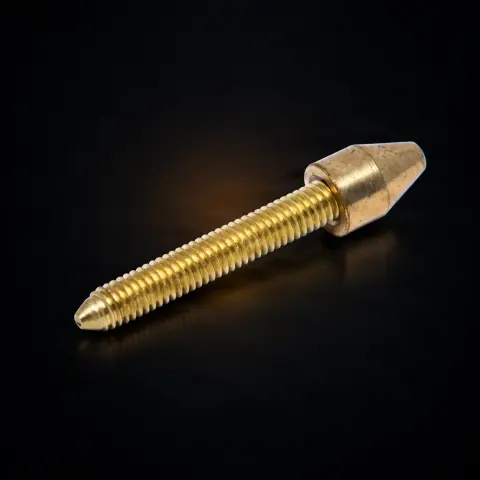
An adjustment screw with a sharp conical tip (spike type) for coil tattoo machines, 38 mm long and 3.8 mm thick. The sharp tip creates a point contact with the machine's spring, meaning a more abrupt break of the electrical contact and a faster response of the electromagnetic mechanism. It is a tuning part designed for tattoo artists working with coil machines who want an aggressive liner with a short, fast stroke — from artists who build their own setup to those who simply want a more defined behavior from their existing machine.
How to use
- Disconnect the machine from the power source before any work on the parts.
- Unscrew the existing contact screw from the machine's support and keep it as a spare or size reference.
- Thread the new screw into the housing — it has a standard precision thread, compatible with most conventional coil machines; do not force it if you feel resistance, first check the thread fit.
- Adjust the gap between the sharp tip and the contact spring by turning the screw finely until you achieve the desired stroke — for a liner, a short and fast stroke is generally sought.
- Secure the adjustment according to your machine's system, so the position does not move during work.
- Connect the machine, start at low voltage and observe the cycle; fine-tune until operation is stable and consistent.
- Before the session, cover the machine completely with a disposable protective barrier, as with any work on a client.
- After the session, clean the tip of deposits with 70% isopropyl alcohol and a soft swab, then visually inspect the tip condition.
Tips from us
- Reserve this screw for liner setups: the point contact and abrupt break produce the fast, energetic cycle that benefits lines; for shading, a rounded tip gives a smoother stroke.
- Pair it with a medium to high hardness contact spring — a too-soft spring can be damaged by the concentrated pressure of the sharp tip, while a stiffer one provides a stable contact point.
- Check the tip at each cleaning: being point-shaped, it wears faster than a rounded one. When it has flattened, replace the screw — do not attempt to resharpen it, as manually recreated geometry is no longer predictable.
- A slightly more pronounced tapping sound compared to a rounded tip screw is normal with point contact — it is part of the character of a fast liner, not a sign of defect.
- At only 4 g and as a wear part, it is worth keeping a spare in your kit, so you don't end up with a misadjusted machine in the middle of a session.
- The silver finish (nickel/chrome coating over brass) is chosen for hardness: it keeps the tip sharp longer than a gold plating, with sufficient conductivity for normal operation.
Frequently asked questions
Will it fit my coil machine?▾
The screw has a standard precision thread, compatible with most conventional coil machines — including classic American and Chinese models. The safest way to check: compare it with your machine's current contact screw. If that one is standard size, this one will thread in without issues. For reference, the part is 38 mm long and 3.8 mm thick.
What's the difference between a spike tip and a rounded or flat one?▾
It's a difference in contact geometry. The sharp conical tip hits the spring at a single point, so the electrical contact break is abrupt and defined — the electromagnet disconnects faster, the armature bar is released more promptly, and the machine responds quicker. Rounded or flat tips distribute contact over a larger area and produce a more gradual separation, hence a smoother cycle. The first option favors fast liners, the second favors shaders.
Can I also use it on a shader?▾
Technically it can be mounted, but it's not recommended. The fast, energetic cycle produced by the point contact is exactly what you want for lining, but on a shader it can lead to too aggressive penetration and uneven ink distribution. For shading, choose a screw with a rounded tip, which gives a slower, gentler stroke.
How do I clean it and when should it be replaced?▾
Clean the contact point with 70% isopropyl alcohol and a soft swab or fine brush, removing carbon deposits and residues. Do not use abrasive materials. Check the tip condition at each cleaning: because the contact force is concentrated on a small surface, the tip progressively flattens over time. When you notice it has dulled or the machine's behavior has changed, replace the screw with a new one — resharpening is not a reliable solution.
Why would I choose the silver version over a gold-plated one?▾
The silver finish indicates a nickel or chrome coating over brass — harder than gold plating, which matters especially for a sharp tip that withstands concentrated pressure. Gold is slightly more conductive, but being softer it would flatten faster. For a spike screw, where preserving tip geometry is a priority, the hardness vs. conductivity trade-off clearly favors silver.
Which contact spring works best with it?▾
Medium to high hardness springs. They provide enough resistance for the point contact and a stable contact point, hence a well-defined electromagnetic cycle. A too-soft spring can be damaged by the concentrated pressure of the sharp tip, so avoid that combination especially at sustained working voltages.
Product description
You might also like
Reviews
No reviews yet. Bought this product? Be the first to leave one.